
The Top 3 Resume Mistakes Costing You the Job
The Top 3 Resume Mistakes Costing You the Job


For this week's issue, I am pleased to introduce our guest author, Ethan Evans, a retired Amazon VP who played a pivotal role in creating some of the groundbreaking services we use today, such as Prime Video, Amazon Video, the Amazon Appstore, Prime Gaming (formerly Twitch Prime), and Twitch Commerce.
Beyond his experience as an engineering leader, Ethan is also a career growth coach who has assisted numerous individuals to get unstuck and level up their careers.
We'll be discussing with Ethan one of the most critical steps in a job search: writing a great resume. Specifically, he'll cover the top three mistakes almost everyone makes when preparing their resume. He'll also delve into details on how to correct them.
If you would like to connect with Ethan, you can do so on Twitter and LinkedIn. Also, be sure to check out his newsletter and career community, Level Up, and explore his range of Leadership Development Courses, including live online classes and on-demand courses.
Ethan, here. I’ve reviewed more than 10,000 resumes in my career and conducted over 2,500 interviews. At Amazon and Twitch, I taught an internal class on how to interview, called “Making Great Hiring Decisions.” I was a “Bar Raiser,” which means I was someone from outside the hiring team designated to join an interview with the power to veto a hiring decision if I believed a candidate was wrong for the company.
Earlier in my career, despite my engineering background, I ran recruiting and had recruiters reporting directly to me at three startups. Today, I coach individuals through their job searches, and I have tested what does and doesn’t work. All this is to say, I know what recruiters and hiring managers want in a resume.
One thing I’ve observed is that 90% of resumes I see contain at least one of three major mistakes. In this article, I will walk you through each one and how to correct it, and then we’ll cover the smaller things you can do to take your resume to the next level; from good to amazing. Finally, we’ll conclude with how to know when to stop worrying about your resume and move on to the next phase of your job search.
Before we get into common errors, let’s briefly review the goals of a resume and what recruiters and hiring managers are looking for when they read one.
First, the goal of a resume is not to get you a job; it is to get you a call. If a resume results in someone reaching out to you, then it has done its job. One driver of mistakes on a resume is trying to make it do too much. We want to optimize our resume to get us on the phone, not to tell our life story.
You have probably heard that recruiters skim resumes in just a few seconds. This is true. Recruiters and managers are under tremendous pressure, and managers often think of hiring as something extra they have to do in addition to their “real” job. Therefore, a resume has to be optimized to quickly catch their eye. Even then, our goal is not for them to read every word, but rather simply for them to place it in the small pile of people to call, before they move on.
The Three Big Mistakes

90% of resumes I see make one or more of three mistakes. If you can address these, your resume will likely be good enough to get you a call.
No objective
Without an objective, a recruiter or hiring manager has to guess if you want their job. If you’re a recruiter with a pile of resumes, some of which state the candidate wants a job like the one you need to fill, and some of which do not, who do you call?
An objective states clearly what kind of role you are looking for in your next job, and a great objective is formulaic and short enough to be read in a single glance.
An example of the formula for a Senior Engineer role would be, “Seeking a role as a Sr. Engineer where I can apply my proven ability to ship scaled services to deliver valuable innovation for the business.”
Let's break this down.
The first part simply states the role you seek. This is particularly important if you are interested in doing something different from your last job. Without context, most people will assume you want to keep doing what you’ve been doing, possibly with a higher level title and more pay. But if you want to switch to management, or change from consulting to traditional corporate employment, then it’s essential you make this clear. Otherwise, people will keep putting you in the box defined by your past.
The second part, “... where I can apply my proven ability to X and Y…” gives you two chances to state your highest qualifications for a role. Right up front, you can highlight the top two reasons to put your resume in the “call” pile.
The third part, “... to create XYZ for the business” shows you are there to help the manager and the company. While you are looking for a “good job” for yourself, the manager is not focused on “giving someone a good job.” Instead, they want to find someone who can solve their problems and help them. Right up front, you want to convey that you are not just interested in yourself, but that you are also dedicated to providing value to your new manager.
I have gotten pushback on the first part of this formula because some people worry that if they clearly state a target role, they will miss out on other possible roles with different levels or titles which they might fit. This is possible, but there are two reasons why it’s best to state a clear objective.
First, there are many candidates for every role. Just like with search results, it is better to be the first choice for one job, than the seventh choice for ten jobs. If the top three candidates get calls, you want to get one call rather than fall below the line on all of them.
Second, you can always have multiple versions of your resume. You can state your objective of securing an “engineering leadership” role on one, and a “product leadership” role on another – if you are qualified for both. Then you can use them for different types of roles.
Let’s look at a few examples:
Organizing Chaos | Managing Change | Driving Efficiency
I am a driven, passionate, action-oriented leader that turns problems into streamlined processes. I led the turnaround of a $10M product line, with a 15,000 basis point (150%) margin improvement (from -125% to +25%) during the 19 months that I managed the products sourcing and operations fulfillment department.
With a background encompassing program, product, and people management, accounting and finance, legal and risk, business operations, analytics, and digital marketing. I’m a multipotentialite who enjoys applying a broad range of experiences and knowledge to new situations. I push myself out of the comfort zone, tackling projects without previous subject matter experience but with ability to quickly obtain visibility into how people with different functions operate. I thrive in organizing chaos: finding and connecting the pieces others often don’t see and building new mechanisms to improve the way we work. My agility, ability to deal with ambiguity, strong business acumen, and relentless search for a challenge, make me the perfect fit for a growing organization undergoing change or in need of transformation.
This is a typical opening section I see on a resume. While the opening paragraph contains an excellent numerical example of a big accomplishment, the second paragraph is seven full lines in which the candidate just talks about themselves in positive terms. It has no data to back anything up and is just a big block of text that most recruiters will skip right over.
Effective and accomplished executive with broad range of experience in finance, operations, strategy, M&A, fundraising, human resources, data analysis, and digital marketing. Proven success in building companies and teams in high growth environments to scale profitability.
This second example is much shorter and more likely to be read, but gets into a long list of disparate areas, leaving the reader wondering what kind of job the candidate actually wants.
Objective: Provide professional development at scale, guiding transitions to executive leadership.
Proven executive leadership of multiple $500M+ businesses across games, video, apps, and music. Global leadership experience of teams of 800+. Technical inventor; 60+ issued patents.
This final example is from my own Executive Coaching resume. It explains in one line what I provide, and then gives two lines containing key examples of my accomplishments that support my ability to do this effectively.
No results, only activities
This is the single most common mistake I see on resumes.
People write down what they did, describe their activities such as that they wrote code, managed a number of people, or worked on this or that project. Some even list their most boring activities, like creating reports or organizing files.
Writing down your work makes you a worker. You will be interviewed and leveled as someone who can be assigned work to do.
Senior performers know that they are valued for their impact rather than their activities. They make a point to show the results of their work, the impact on a team, company, or business.
Consider the difference between:
“As a part of Project X, wrote Java code to implement several critical microservices.”
And
“As a part of Project X, wrote Java code for several critical microservices, allowing it to support enterprise environments, resulting in several key new customers buying the product.”
Which engineer sounds more senior and valuable?
It is usually possible to rewrite nearly every bullet on your resume in a way that describes why your work mattered, not just what you did. Try to show that your presence made a positive difference to a team, product, and the bottom line.
The good news is that there are advanced tricks you can use to make this compelling:
If possible, link to your results. People exaggerate and lie on resumes whereas nothing says “my work is real,” like a link to the project.
The human eye is automatically drawn to bold. You can selectively bold a few keywords or phrases to ensure your very strongest accomplishments are noticed.
Use action verbs, such as ‘owned,’ ‘built,’ ‘drove,’ or ‘delivered’ to give your bullets an “active voice.” This suggests you actively did something, rather than just be passively present when it happened
People believe specific numbers. Resumes with numeric results in the bullets get 132% more calls than those without them. I just made that point up, but I bet you believed it.
Where possible, include dollar figures if relevant to the results.
Let’s apply this to our example and see how strong it becomes:
“Delivered several critical microservices in Java for Project X, allowing it to support enterprise environments. This resulted in a 74% increase in service usage, including adoption by several key new customers, generating $29M in incremental revenue.”
Now, who do you think the company wants to hire?
Let’s look at some real examples of the differences between generic resume bullets not focused on numeric results, and compare them to some designed to showcase results.
Typical bullets:
Manage information technology for the organization, access control, security, and onboarding/offboarding users.
Draft, monitor, and maintain policies and procedures to support the organization’s information technology.
Develop relationships with vendors and partners for supply chain, on-site network infrastructure, information security, and software lifecycle.
Develop and manage a roadmap for changes to systems architecture. Ensure transparency of roadmap and timeline, and communicate often with stakeholders about the status of work.
Partner with internal stakeholders to develop processes and system recommendations.
Manage enterprise systems projects and ensure that projects are completed accurately and on time.
Evaluate end user needs, organizational goals, budgets, and existing applications to define system requirements and technical standards.
Bullets with clear, numeric results:
Planned, built, and deployed 100% cloud and SaaS infrastructure in a greenfield startup.
Fully automated employee hardware lifecycle, reducing onboarding time per employee from 2 hours to 10 minutes.
Engineered and deployed scalable blueprint for SD-WAN networks for an organization of 1,000+ schools.
Created and deployed end-user knowledge base, reducing engineering support tickets from 50 per week to 5 per week and a time-to-close metric of 15 minutes.
Next, let’s look at the same job from a real resume, described in two different ways. The first description is typical and tells you what the person did. The second description is the exact same content, but it’s organized to emphasize impact, and show active leadership of projects.
First description:
Created an Electron application to enable third-party developers to develop and test Twitch Extensions. Designed and implemented a Twitch SDK in C++ for Windows Desktop, PlayStation 4, Xbox One, and Nintendo Switch, in Typescript for Node, and in Python for Python applications. Designed and implemented a machine learning solution in Python using MXNet to recognize events and states in a Twitch stream.
Second description:
Created improved media components for Twitch’s streaming solution, Twitch Studio, resulting in a 30% decrease in memory utilization.
Created an Electron application to enable third-party developers to develop and test Twitch Extensions.
Designed and implemented a Twitch SDK in C++ for Windows Desktop, PlayStation 4, Xbox One, and Nintendo Switch, in Typescript for Node, and in Python for Python applications to enable third-party developers to integrate with Twitch’s developer ecosystem.
Designed and implemented a machine learning solution in Python using MXNet to recognize events and states in a Twitch stream. This enabled Twitch’s advertising team to improve user experience of mid-roll advertisements.
Too many words
Many resumes are very long. They may go on for three or more pages, or use a tiny font with no spacing, and cram the page, making a “wall of words.”
A few things drive this behavior:
A mistaken belief that you must include everything you ever did on the resume
The fear that the one thing you omit will be the exact thing they want
A natural desire to “be known” and tell your full life story. A desperate faith that if only the reader can see all you have done, then they will be sure to hire you
In all cases, the mistake is writing what we want to write about, rather than what the reader needs to know.
I call this behavior, “happy words.”
“Happy words” occur when a resume opens with the candidate writing several positive sentences about who they think they are as a person. It usually looks like this:
“Motivated self-starter looking for a positive environment where I can bring my technical skills and passion to a worthy project. Great coworker and mentor. Adaptable, fast learner. I love travel and my two furry friends, Max and Luca.”
It is natural to want to share what we see as our most positive traits. Unfortunately, as a cynical manager looking at dozens of resumes a day, I will simply ignore all of this. First, it does not tell me anything about what the candidate can actually do. Second, it is just a self opinion without proof.
The rule to follow is “show, don’t tell.” If you believe you are a fast learner, then include bullets on your resume that show this: “Learned and applied X to new project, going from first effort to customer shipment in 9 weeks.” On a resume you want to demonstrate your strengths through your results, not talk about them in a lengthy opening “summary” no one will read or believe.
As one benchmark, my resume for a 30 year leadership career, complete with roles, education, special achievements, and more, fits comfortably on two pages and uses about 700 words. Count the words in your resume. If it is over 1,000 words, start cutting.
Remember, your goal is not to tell a recruiter or hiring manager your life story, it is to put your three best accomplishments per role in front of the manager, so they cannot miss them. If you write too much, they will skim over it and may miss your biggest accomplishments.
Both men and women write too many words, and in my experience, it is most common with women. Research shows that women typically don’t apply for a role unless they feel they meet almost every listed requirement, and I believe this same basic drive leads to a belief that it’s essential to include everything on the resume, to be seen as fully qualified. Whether you’re female or male, fight this tendency and stick to clearly highlighting your strongest results.
One way to get a picture of what your resume should look like is to think of it as what it is: a marketing sheet for you as a ‘product.’ If you have ever seen an advertisement for a more complicated product, it will be attractively laid out with some white space and a nice use of color. It will absolutely include relevant technical specifications and data, but only enough to pique your interest. Your resume should do the same.
Here is a real resume with a total of 1,420 words, covering a 12-year career:
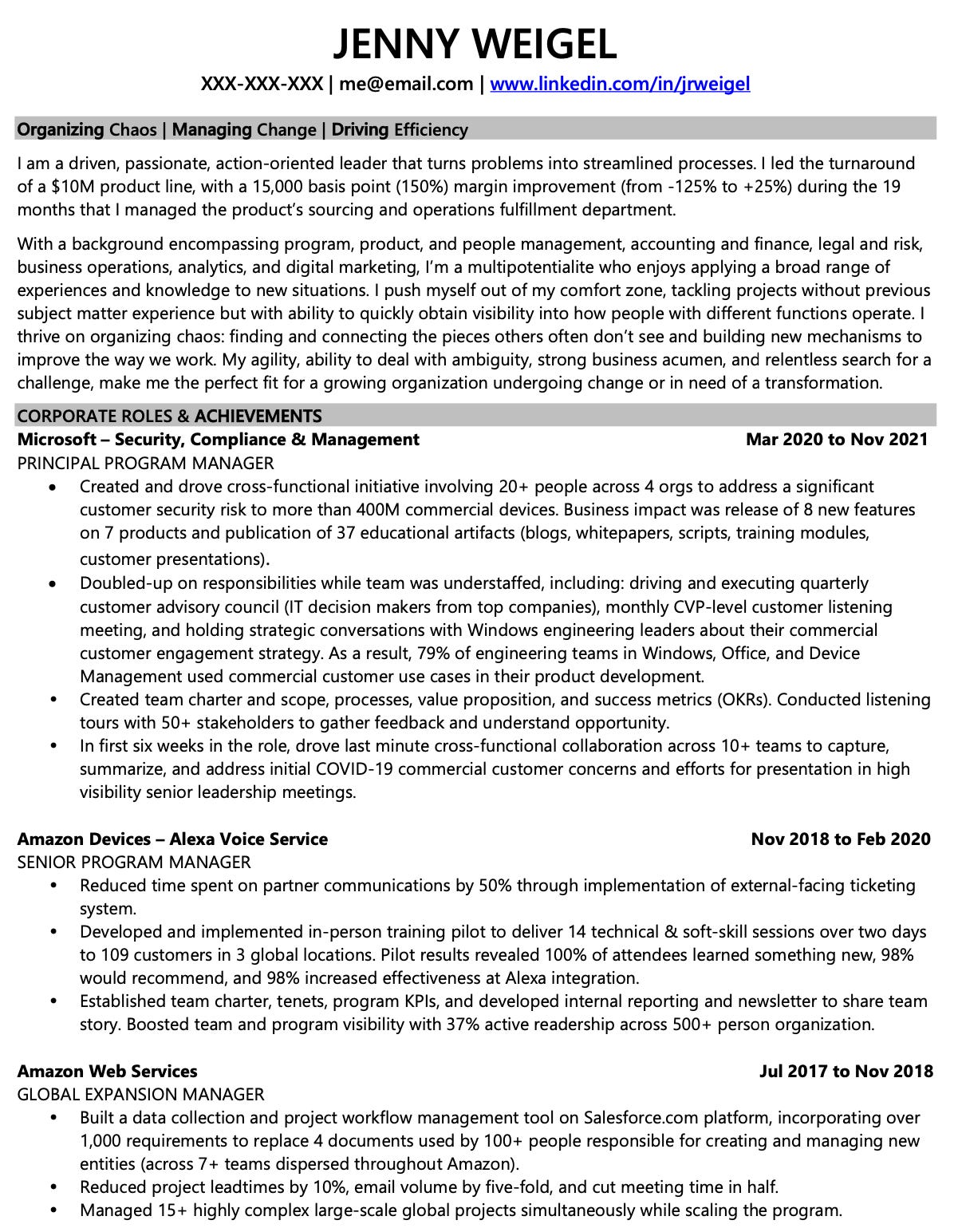
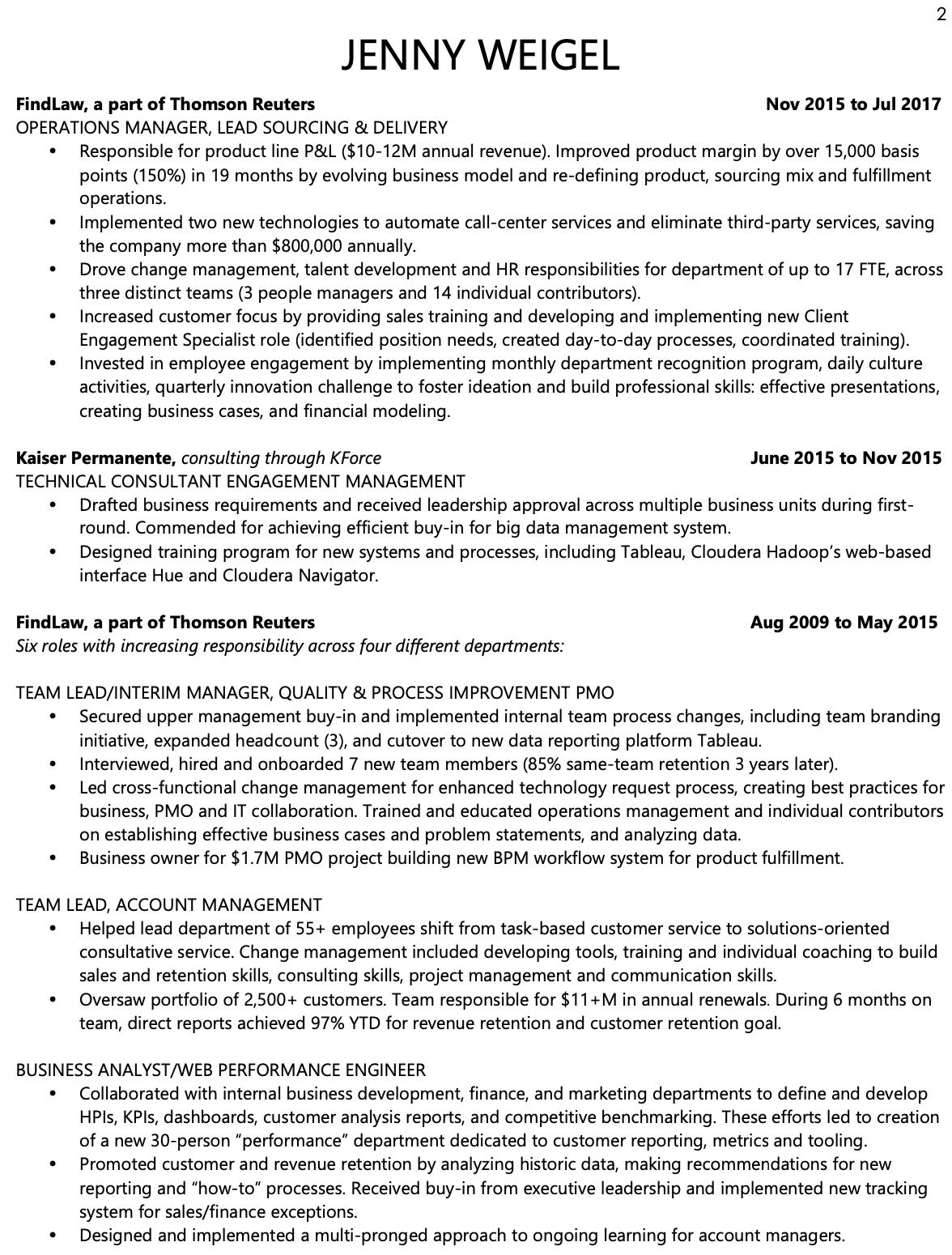
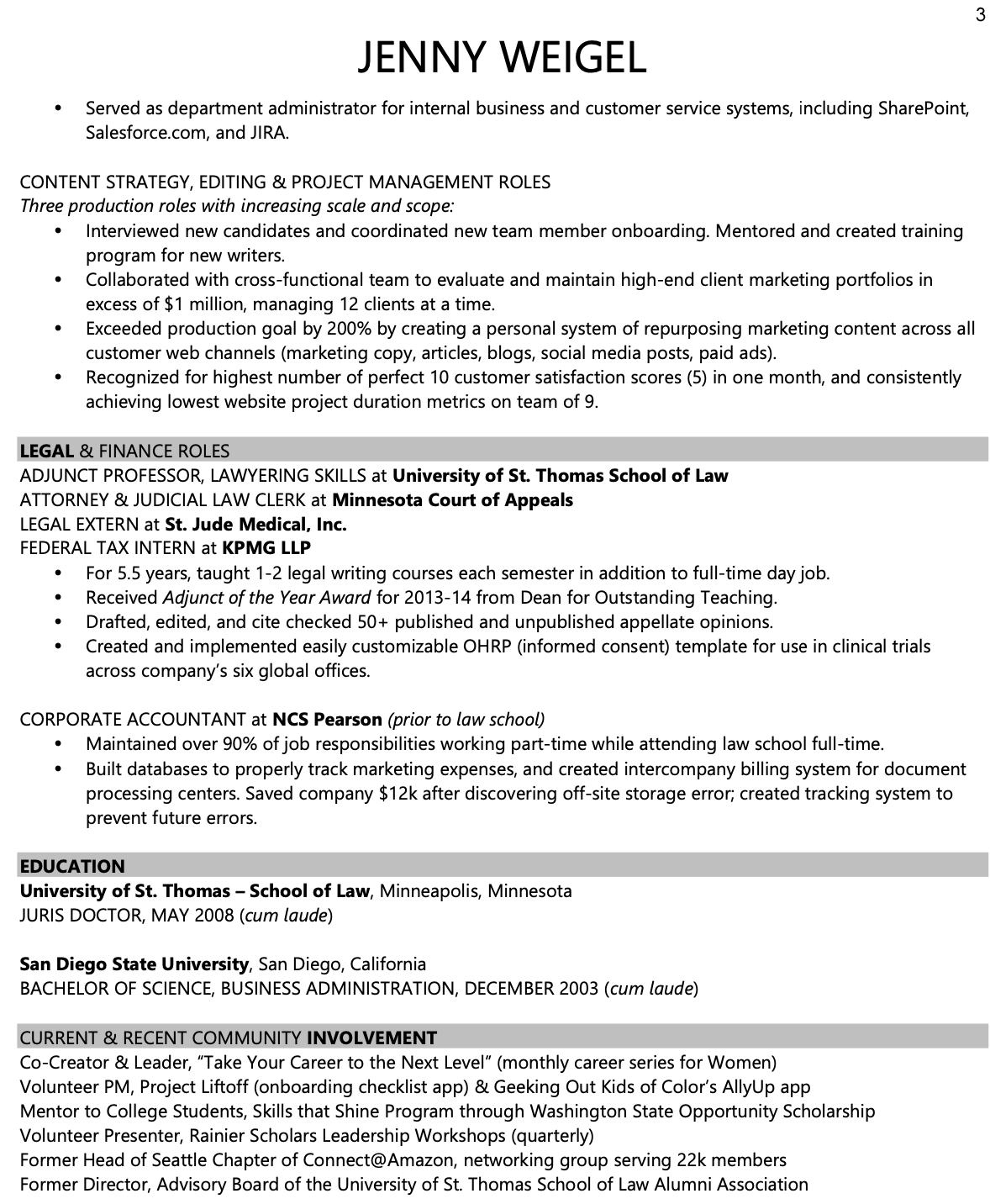
Here is my resume, using 700 words to cover a 30-year career. Note that the last page can be dropped entirely to create a two-page resume.
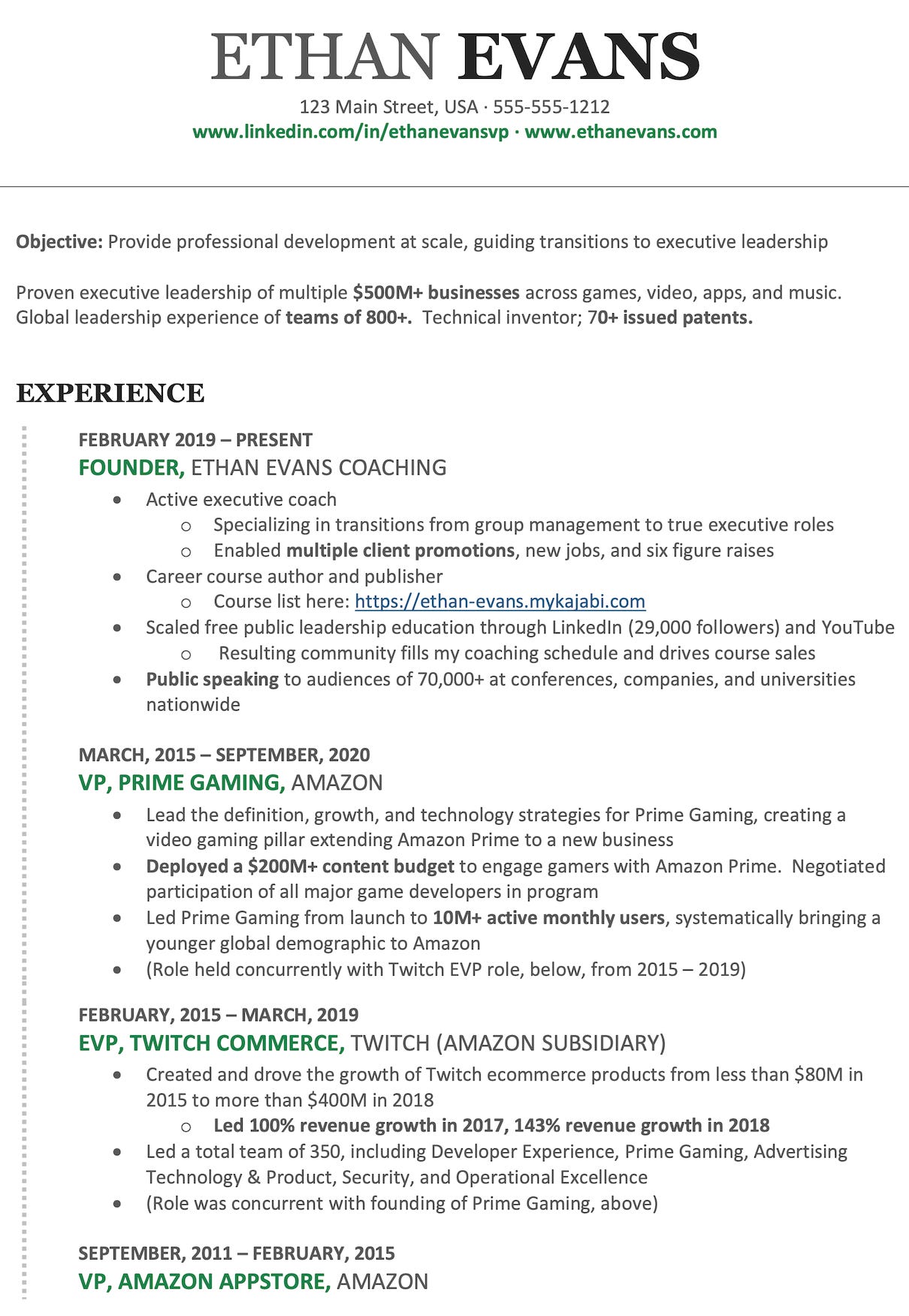
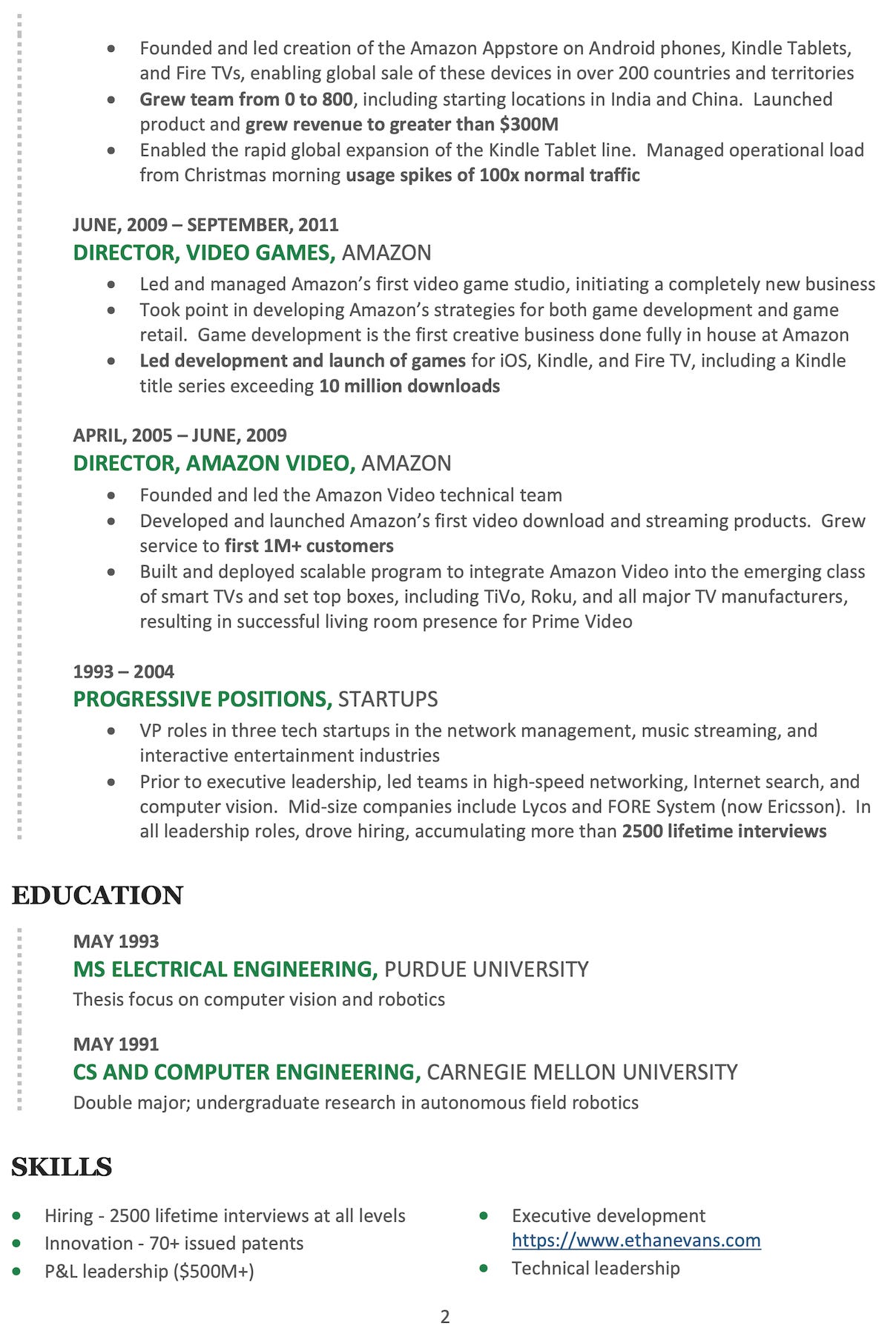
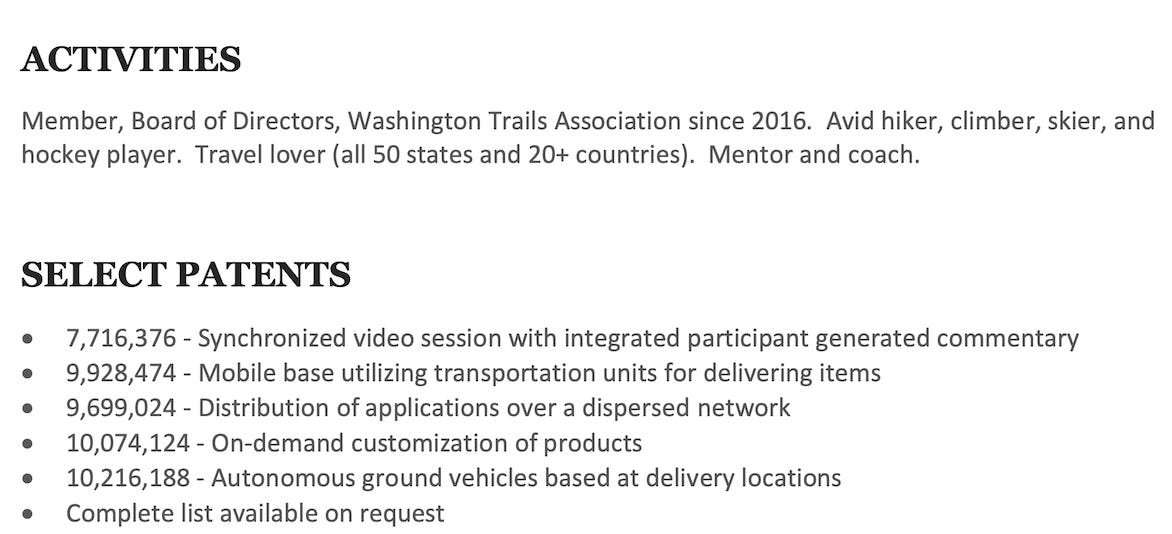
This resume was created from scratch in two hours using a standard Microsoft Word template. Making a good resume does not have to be difficult.
Beyond the Big Three Mistakes
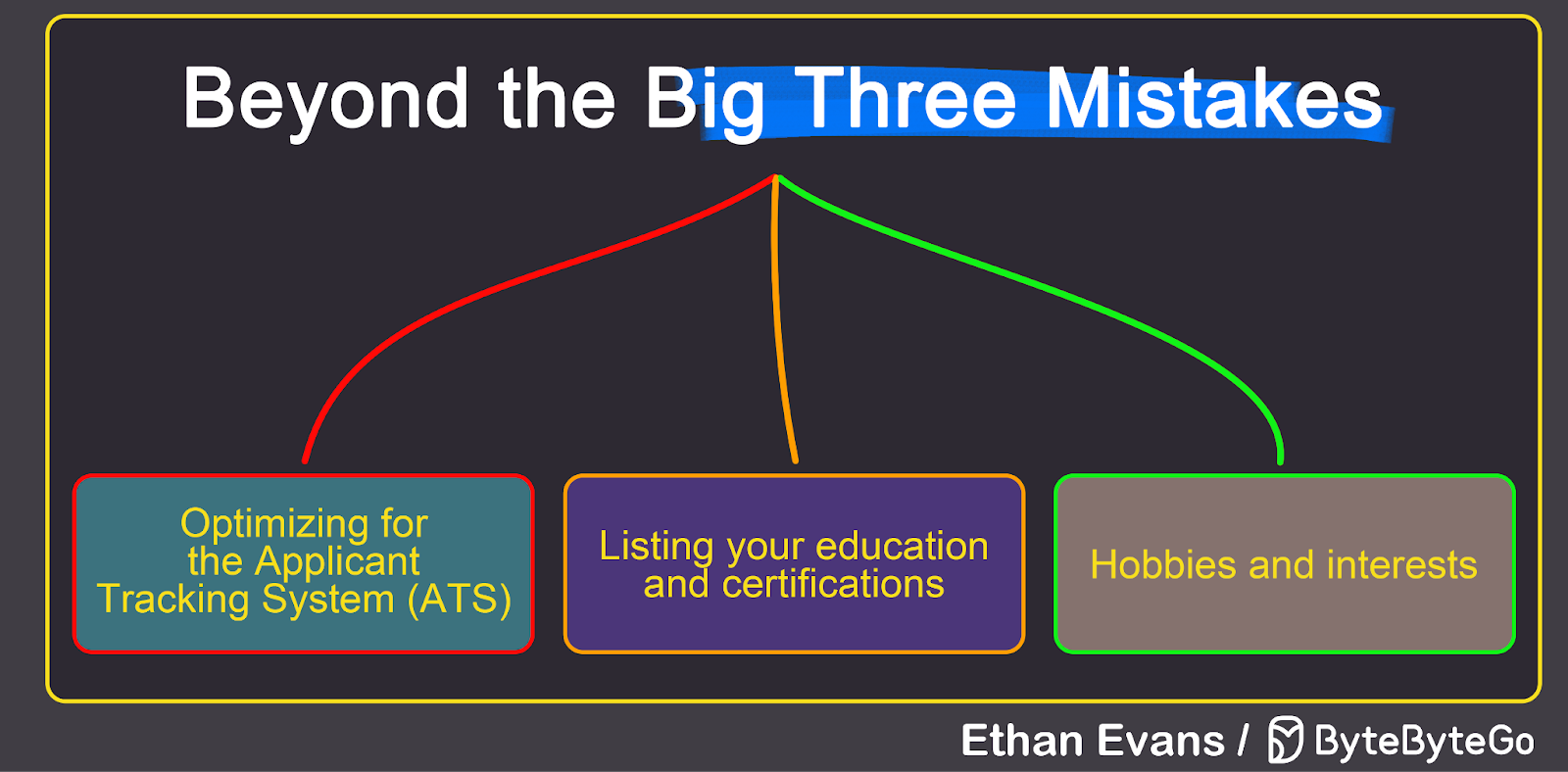
Optimizing for the Applicant Tracking System (ATS)
Many resumes, even those of more senior individuals, try to cram in a large number of keywords at the top of the document, in an effort to pass a filter in the applicant tracking system.
There are two significant problems with this approach. First, Forbes magazine reported in 2023 that over 80% of all jobs go to someone with a networking connection to the role. Focusing on getting through the ATS filter means focusing on 20% or less of available jobs; the same ones everyone else is flooding with resumes.
The second problem with putting a big block of keywords at the top of your resume is that it makes the resume hard for a human to read. It buries your strongest accomplishments down in the body of the text. The ideal approach is to write your resume for human eyes, then leverage your network to get it into the hands of someone who will read it.
If you want to include a big list of keywords or technical terms, put them at the end of your resume in a ‘skills’ section.
Listing education and certifications
If you are a new graduate, the expected resume format is to list your college information at the top. If you have real work experience, even just a full year, your education should move down below your work history. I see resumes of people who are five or more years out of college, but who still have a college-style resume, which does not highlight how effective they have been in the last 5 years. This is probably because they have just kept updating the same old resume. If this is you, change it to highlight your skills.
Another question is whether or not to include your grade point average (GPA), or other graduation rank. Simply put, if you do not list it, the reader will assume it is poor. So, if you have a lesser GPA, feel free to leave it off because it won’t hurt you. But if you did pretty well, say, anything above a 3.3; then you are better off listing it to avoid the assumption that you barely graduated.
The bottom of your resume is also the right place to list most certifications, unless you have a very critical attribute like a government security clearance, or a clearly expected certification for the type of role you seek. In such cases, it can make sense to list them near the top. But if you have collected numerous small, lesser-known educational experiences, they should go below your actual work history. Few people have ever been hired for completing a six-week certificate in data science.
Hobbies and interests
This should be the last section of your resume. There are two benefits to ending your resume with a little interesting information about hobbies, charitable activities, and interests.
First, these interests humanize you, making you more of a real person than just a collection of professional accomplishments. If someone has read to the bottom of your resume, it means you won their attention, and they are now seeking to know you better. Talking about yourself at the top of your resume hurts you, whereas giving a little personal texture to your resume at the bottom can help you be memorable.
Second, managers and recruiters are often looking for an ice breaker if they are going to call you. Maybe they ski too, or also have a dog, or volunteered to fight homelessness. By listing a few such things, you create more chances to connect emotionally with an interviewer.
Next Steps
At this point, you should have a very clear resume that’s easy to read. Congratulations!
It is worth noting that with thousands of managers and recruiters out there, you can find someone who loves a type of resume, and someone who hates that same resume. Ultimately, your resume is a tool, and the key is to be confident that it represents you clearly and effectively.
To this end, a trap that I see my clients fall into is continuing to revise and polish their resumes, when they really should be doing the uncomfortable but necessary work of networking to get an introduction and a good reference for a job. Do not let working on your resume turn into procrastination about your job search!
Remember, a resume cannot get you a job by itself, it can only get you a phone call. Make the changes above, get feedback from a couple of readers, and then move on with your search!
Finally, the other mistake I see many candidates make is failing to copy their excellent resume text onto LinkedIn. In many ways, the traditional resume is becoming a dinosaur. Starting five years ago, more and more recruiters simply send me a candidate’s LinkedIn profile link to consider. Your profile serves as an online resume, so make sure it serves you well.
To get the most out of LinkedIn, put your crisp objective statement in the “About” section of the profile. Then, copy your carefully crafted job bullets into each section of “Work History”. Fill out your education and other information, and keep it up to date. This way, recruiters can find you while you sleep. You can also include a simple link to your profile in place of a resume attachment in network posts or messages.
Thank you very much, Ethan, for sharing insights on how to write a great resume.
If you would like to connect with Ethan, you can do so on Twitter and LinkedIn. Also, be sure to check out his newsletter and career community, Level Up, and explore his range of Leadership Development Courses that include live online classes and on-demand courses.


 | A guest post by
|


