
Why Executives Seem Out of Touch, and How to Reach Them
Why Executives Seem Out of Touch, and How to Reach Them

For this week's issue, I am pleased to introduce our guest author, Ethan Evans, an ex-Amazon VP who played a pivotal role in creating some of the groundbreaking services we use today, such as Prime Video, Amazon Video, the Amazon Appstore, Prime Gaming (formerly Twitch Prime), and Twitch Commerce.
Beyond his experience as an engineering leader, Ethan is also a career growth coach who has assisted numerous individuals to get unstuck and level up their careers.
If you would like to connect with Ethan, you can do so on Twitter and LinkedIn. Also, be sure to check out his newsletter and career community, Level Up (ByteByteGo readers get a 25% discount off the annual subscription—highly recommended for more deep executive insights), and consider his highly rated live course on how to get unstuck and break through to the next level in your career.
Employees in larger organizations often feel surprised and disconnected from the actions and decisions of their leaders. The bigger the organization and the more distance to the leader, the more likely it is that their choices will be surprising and seem “out of touch.”
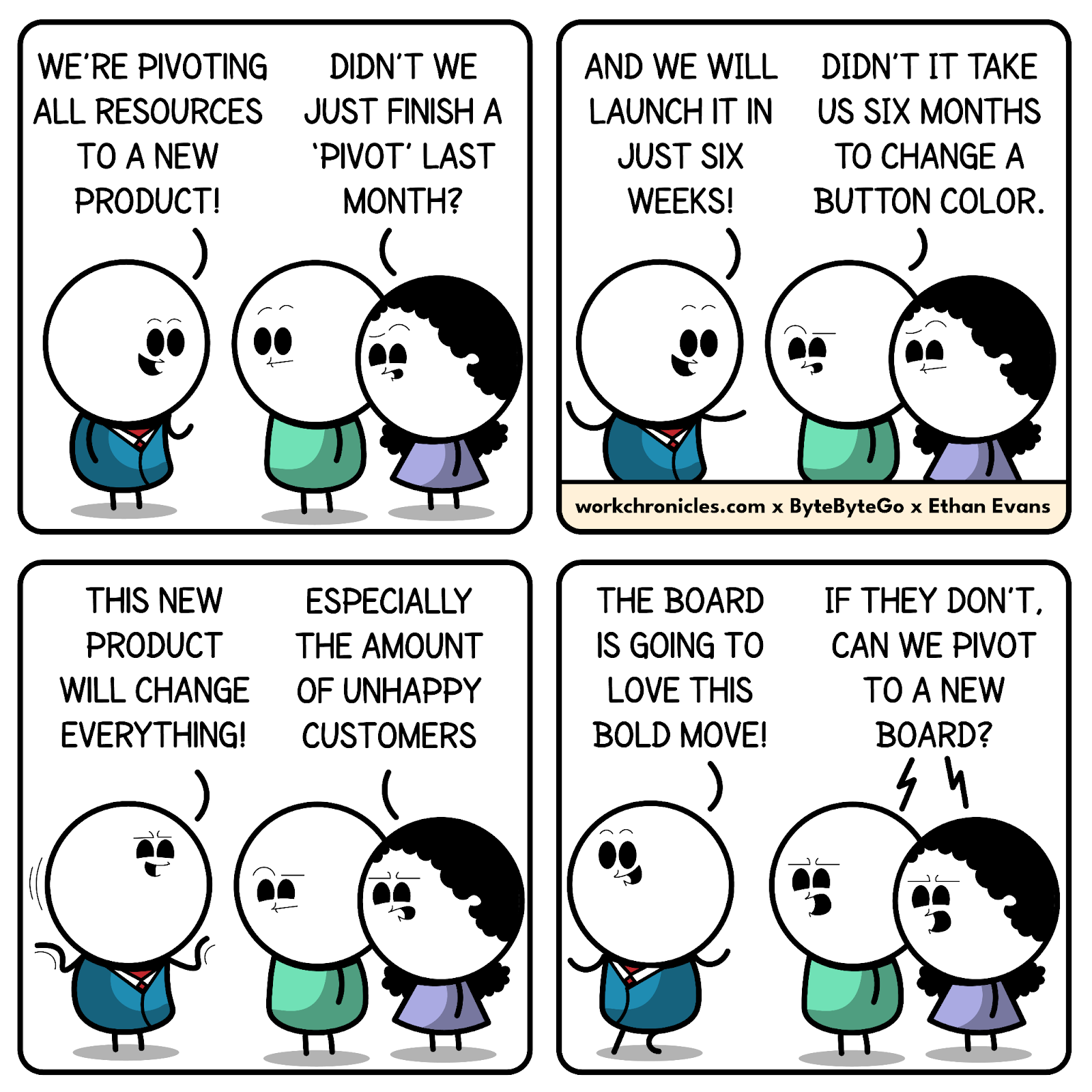
This lack of understanding of executive decisions can lead to employees feeling unheard or unseen and ultimately can damage the employee’s sense of belonging in the company culture. For this reason, I want to shed some light on what is going on behind the curtain when executives make decisions. If you understand what they are thinking, you should be both happier and more able to succeed in their teams.
In this article, I will explain three things:
What we as executives are trying to accomplish
How we normally approach decision making
Why we sometimes seem out of touch or fail to explain our actions and decisions
As I cover this, I will insert some specific tips and actions you can take to work more effectively with executives to get what you need.
Understanding The Executive Job
A CXO, VP, or Director is paid to do three things:
Help figure out what the company should do to succeed (“strategy”)
Guide their team to make those things happen (“execution”)
Handle the endless problems, negotiations, and exceptions that block the first two (“influence and escalations”)
To fully understand executive roles, we must remember that companies exist to make money. The job of any given executive is either to directly make that money or to do something that leads to making the money (build new and valuable technology, manage and reduce costs, find more customers, etc.)
Given the number of messages and meetings each day, many executives lose sight of these key goals much of the time. But, to understand what they are doing, you must first understand what they are trying to accomplish.
How Executives Do Their Jobs
On a “normal day” an executive is most likely trying to gather information they need, share information others need, develop their team members, and resolve problems.
At a basic level, most of what an executive does is communicate, with some periods of thinking and analysis squeezed in along the way.
Here is what my days looked like a VP of an 800+ person spread out across multiple countries:
My calendar was always booked from 9 AM to 6 PM every day. Often, even after my talented executive assistant had negotiated with all the other talented executive assistants, I would be double booked and would need to choose which meeting to go to on the fly.
My lunch was usually brought to me, so I could either eat at my keyboard while trying to stay caught up on email or in a meeting. In addition, there would be an hour or two of email catchup in the morning and evening outside of work hours and on most weekends.
If a life of constant meetings sounds unpleasant, it is. There are good things about the executive role, but most executives I know have had similarly packed calendars. The key to sanity is not usually to have fewer meetings but rather to set up the meetings to be useful and get the right things done. Good executives also get used to switching contexts every 30 to 60 minutes. While engineers seek to get into uninterrupted flow, executives have to get good at handling interruptions.
In this sense, an executive often acts like a big switch or Internet router
We gather information from you and give it to others (our manager, our peers) who need it
We take information from them and give it to you
We make proposals to our peers and managers to try to set the strategy or align schedules
We make decisions (when we can) to resolve problems, clear blockages, and set direction
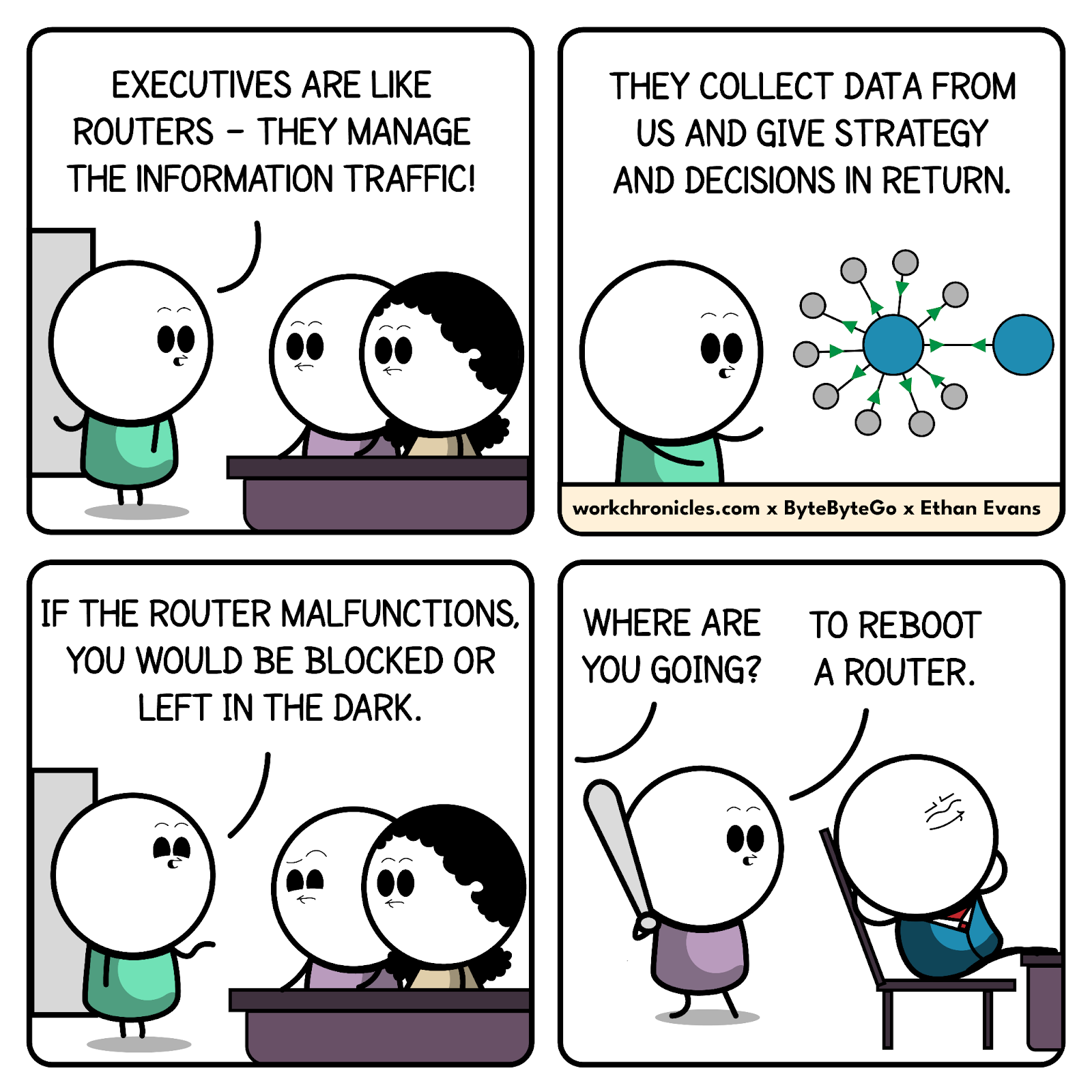
The job of the executive is to figure out who needs what information to get their work done, and then get it to them quickly. Executives who do this well are effective. Executives who do this poorly either become blockages (you end up waiting for decisions), or leave you in the dark (they forget to share information or do not realize you need it).
Meetings generally serve the purpose of helping the executive collect and distribute information. In any given meeting, I may start by gathering information from the people in the room, then move on to discussing problems or blockages that come up. If possible, we then use the meeting to make decisions on those blockers. I will probably also share some context or direction I have gotten from other meetings, such as what other teams need from us, what they have agreed to in order to help us, and perhaps new goals or initiatives.
Types of Executive Meetings
Generally, meetings fall into two broad categories:
Business meetings, which includes project status updates, marketing plans, proposals and decisions, etc. These meetings exist to try to get new things done; they are about growing the business.
Operational meetings, which include one-on-ones, interviews, financial reviews, talent assessments, and technical operations reviews. These meetings exist to maintain the company's infrastructure, take care of the existing products and services, and manage and grow team members.
It is important to do enough operational meetings that the company runs well, but not so many that nothing new gets accomplished. One of the ways companies fail is that over time they add more and more review work so that most of their time is spent maintaining what exists rather than creating or improving products and services.
Actions to Succeed:
Schedule time with your executive early, through their EA. Tell the EA why it is important that the meeting not be shifted or pushed out when conflicts arise.
“Be bright, be quick, be gone.” Whether in a meeting or in an email, get to the bottom line quickly. If you need to share a lot of data, you should state the key conclusion first and say that you will share the data next. For example, “Project X is off schedule and at risk of being late. Let me walk you through why this is true and what options we have to reduce the delay.”
Think about what information your executive may need to know about your work and your team, and then send it without being asked. This makes you look insightful and ensures that you get to share what you want, when you want. Waiting to be asked means your work may go unnoticed.
Big Decisions and Crisis Management
In addition to the “normal” pattern of meetings, it is worth covering two types of special events: Big Decisions and Crisis Management.
Big Decisions
At least a few times a year, an executive needs to make a big, ambiguous decision. Such decisions have the potential to either make or lose a lot of money, and there is no “certain” right answer.
Even in situations where a potential plan is likely to work, there are two risks that cannot be easily eliminated. First, a competitor might move faster, turning a good plan into a “me too” initiative while you are working on it. Second is the idea of opportunity cost. Since companies and teams have limited resources, placing a bet on one project means not betting on another one.
Executives try to make these decisions well, but at the same time, they need to make them quickly. Because competition is one of the issues, many companies also try to keep these decisions a secret.
This need for speed and secrecy is a main reason that executives can either seem to be out of touch or leaving you in the dark. Asking everyone on the team for input and telling everyone the plan goes against the principles of moving fast and keeping competitors in the dark. Not all companies handle these the same way, so if you change jobs you may feel more or less included and informed.
From a process viewpoint, executives often hold a series of planning or information gathering meetings in the weeks before a big decision. At Amazon, we would prepare a “six page narrative,” the company’s well known written proposal document. Other companies will create a Keynote or PowerPoint deck.
For the decision, executives and key senior team members gather to review and discuss the information gathered. The best outcome is a clear decision that can be implemented. However, we often realize that we need additional information or want to look at different options. In this case, the team is sent off to gather new information and revise the document. Then we go through the review process again.
A common mistake executives make is leaving their organizations in the dark for too long.
One reason for this is that executives are often optimists. They assume that preparation for the meeting will go quickly and that a clear decision will be made, and they plan to share the outcome with the team as soon as this is finished. With the best intentions, they say nothing before then, not wanting to worry team members with things that are uncertain.
But, as the preparation drags on and meetings are delayed because a key person is out of office, no decision is made. What was intended to be a week or two of silence becomes months. Worse, when the decision is made, there is rarely a discussion of how to fully explain the reasoning to everyone who needs to implement it.
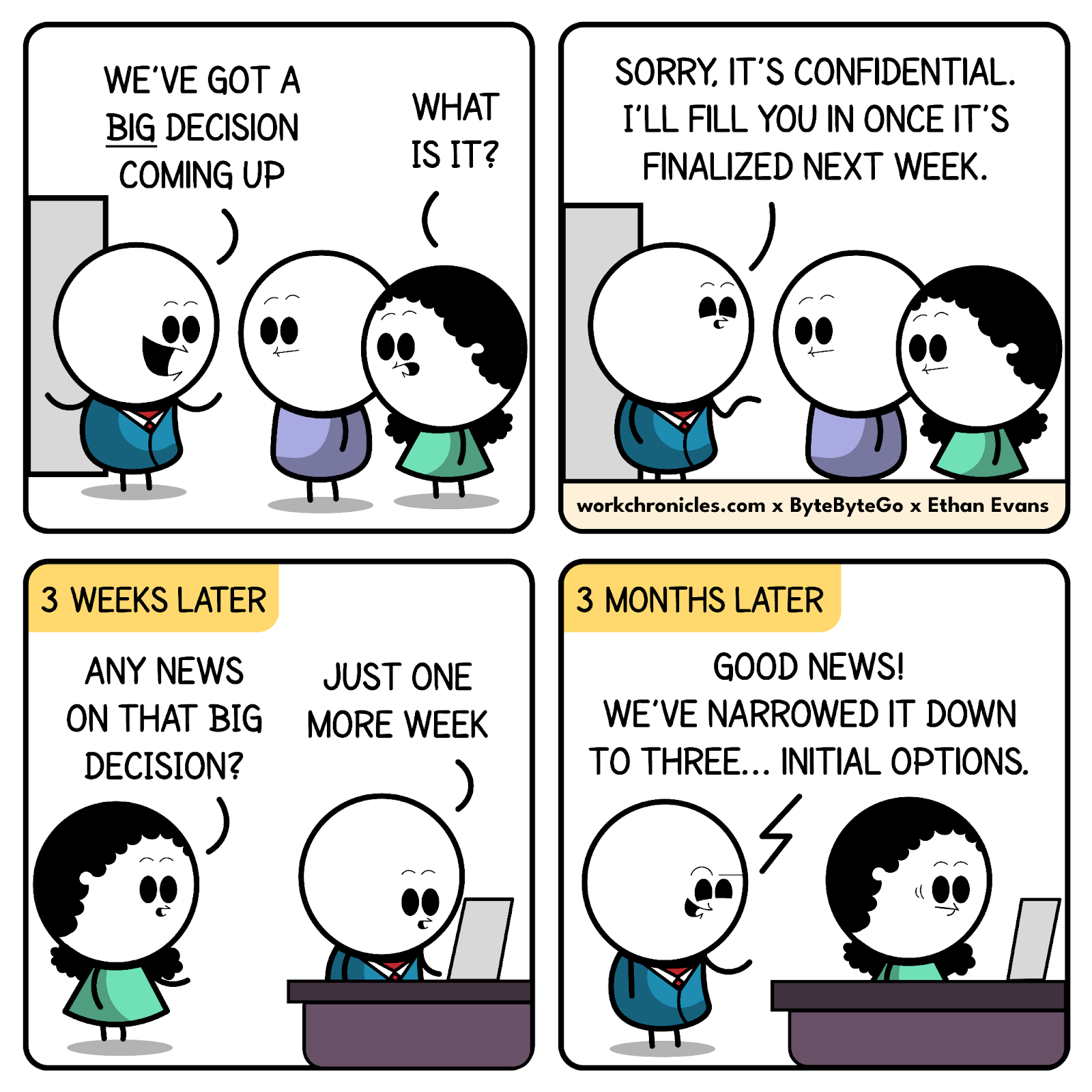
As a result, if you find yourself getting what you see as new directions with little explanation, you can know it is as much a side effect of the process as it is cluelessness or incompetence.
Another trap that executives fall into is something everyone experiences: Something is very clear in their head, but they struggle to explain it all and take parts of the idea for granted as something everyone will understand. After spending weeks on a decision about a new project, they are familiar with every detail of the new plan. This often leads them to forget that you have been in the dark and have none of this context.
Actions to Succeed:
As mentioned, get in the habit of keeping your leadership team informed about your work. You never know when they may need the information, and keeping them in the loop is a good practice to be in the habit of.
If you learn a big decision is happening, try to find out who the stakeholders are and what is important to them. The more you know about what is being considered, the easier it is to both influence an outcome if you have an opinion and also to understand the ultimate decision.
Once a decision is made, be sure to ask your executive what was decided, what they need from you or your team, and why. The more you can learn about why a decision was made, the more your will be able to make your own choices on the next steps. You make better choices when you understand the goal of the decision, not just whatever specific work was assigned to you as a result.
Crisis Management
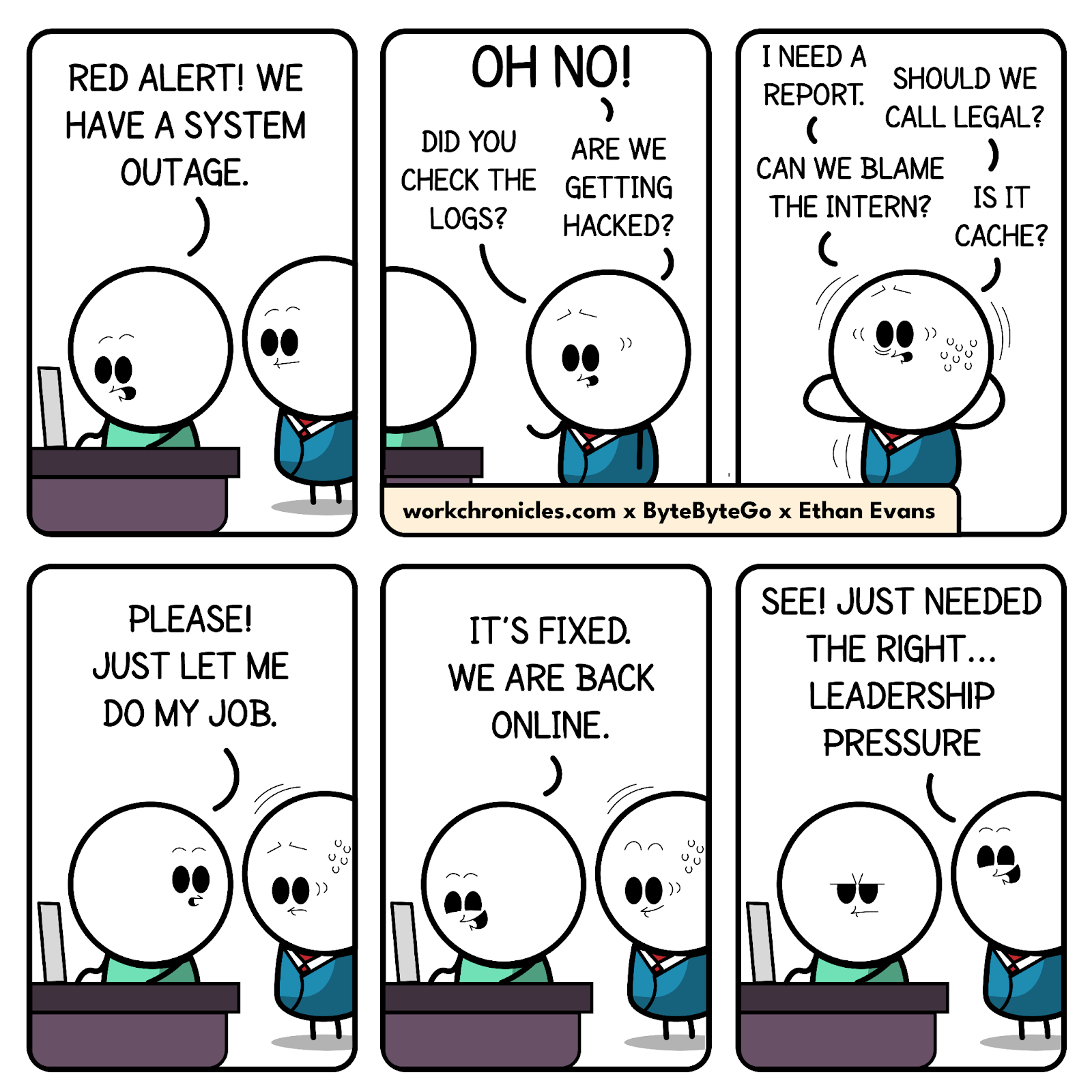
A system outage, the loss of a big customer, or any other sudden problem can shift an executive into crisis management. While occasionally an executive will show the same behavior around a positive opportunity, such as closing a large deal or buying another company, usually these events are negative surprises.
When something goes badly wrong, a leader must drop everything to coordinate the response. In cases like this, I would message my EA to “clear my calendar.” Then, with all meetings canceled, I would go into a “war room” with the team and focus solely on the critical issue.
I got good at crisis management, which involves:
Clarifying the problem
Getting the right people in the room
Communicating status to leaders while the experts work
Getting experts the resources they need
In this post, I wrote about surviving a crisis where I personally disappointed Amazon founder Jeff Bezos.
I then wrote a follow-up post on how to care for your team in a crisis, the mistakes I made, and the lessons I learned.
Perhaps surprisingly, I came to enjoy crisis management because it allowed me to focus on just one thing. While I did not like the bad news, once I got good at managing a crisis it was nice to be able to ignore the meetings and go deep with my team on an issue.
Actions to Succeed:
Focus on the problem, not on blame! Blame is never healthy, but spending time on it before the problem is fixed is double folly. If your executive gets too interested in the blame, suggest a “post mortem” after the crisis is over, then set the ground rules that the post mortem is about preventing future issues, not finding a scape goat.
Fix the problem before investigating root cause. One of my best engineers was oncall when the Amazon Appstore went down. His natural curiosity led him to spend time studying the situation to figure out what had led to the issue before taking any action to restore service. I got on the call and had him bounce the servers. It is absolutely true that rebooting might have erased evidence and left us vulnerable to a repeat outage, but the service came back up in working order. Most executives would prefer to take their chances with a more difficult bug hunt after an outage than to prolong the downtime to do research.
Following point number 2, implement good logging before you need it. In multiple critical outages, including the one above, detailed logs allowed us to figure out what went wrong and prevent a reoccurrence after the initial problem was resolved.
Tell your executive what you need. Be clear with them if you need something to fix a problem. Another good engineer on my team once rolled back another team’s deployment without telling them, a huge breach of protocol. Had he told me, I could have called them and quickly gotten agreement on what to do. Instead, he brought me in late and we had to manage a second crisis (an offended team and manager) on top of the initial problem. Your executive wants to help, so give them a job to do. Though I love the funny cartoon above, I learned to take on the job of “keep everyone else out of my team’s way” – I would focus on communicating to everyone who wanted to know the status of the fix so that my team members could actually fix things.
Do not be afraid to accept help. An outage is not the time to be full of pride about your ability to figure it out on your own. During big outages, I brought in whole rooms full of Amazon’s Principal Engineers. This brought us fresh, smart eyes and also created vital “air cover” with stakeholders. When your systems are down everyone will be eager to doubt you, so having several highly respected engineers from outside your team in the room will convince them that you aren’t “hiding anything” and you are doing all you can.
All in all, executive behavior can be explained by many factors of business operations and human nature. It is very rare that an executive is keeping you in the dark just to be vindictive or even secretive. Seeing even the most unusual or frustrating actions as probably unintentional will both make you happier and make it easier to ask questions. With that said, you should always do your best to understand why the executives are making the decisions they make so that you can take the best course of action as a result.


 | A guest post by
|


