

Distributed Caching: The Secret to High-Performance Applications

The demand for high-speed, high-performance applications has skyrocketed in recent years.
With users expecting real-time responses, especially in sectors like e-commerce, finance, gaming, and social media, even a few milliseconds of delay can lead to a poor user experience, potentially impacting customer satisfaction and revenue.
One core technique to accelerate data retrieval and improve application responsiveness is caching.
Caching works by temporarily storing frequently accessed data in a high-speed storage layer, often in memory. This allows applications to retrieve information faster than if they had to pull it from the primary database each time. A single cache node is often sufficient for smaller systems or applications with a limited user base to store and serve frequently requested data.
However, as systems grow, this setup faces limitations. Relying on a single-node cache to serve large-scale, high-traffic applications can lead to multiple problems.
This is where distributed caching comes into play.
Distributed caching involves spreading the cached data across multiple servers or nodes, allowing the cache to scale horizontally to handle large-scale applications. With a distributed cache, data is stored across multiple locations, meaning a single-node failure doesn’t compromise the entire cache, and the system can continue to serve requests seamlessly.
In this article, we’ll explore the concept of distributed caching in depth. We’ll look at how it works, discuss its key components, and examine common challenges and best practices for implementation.
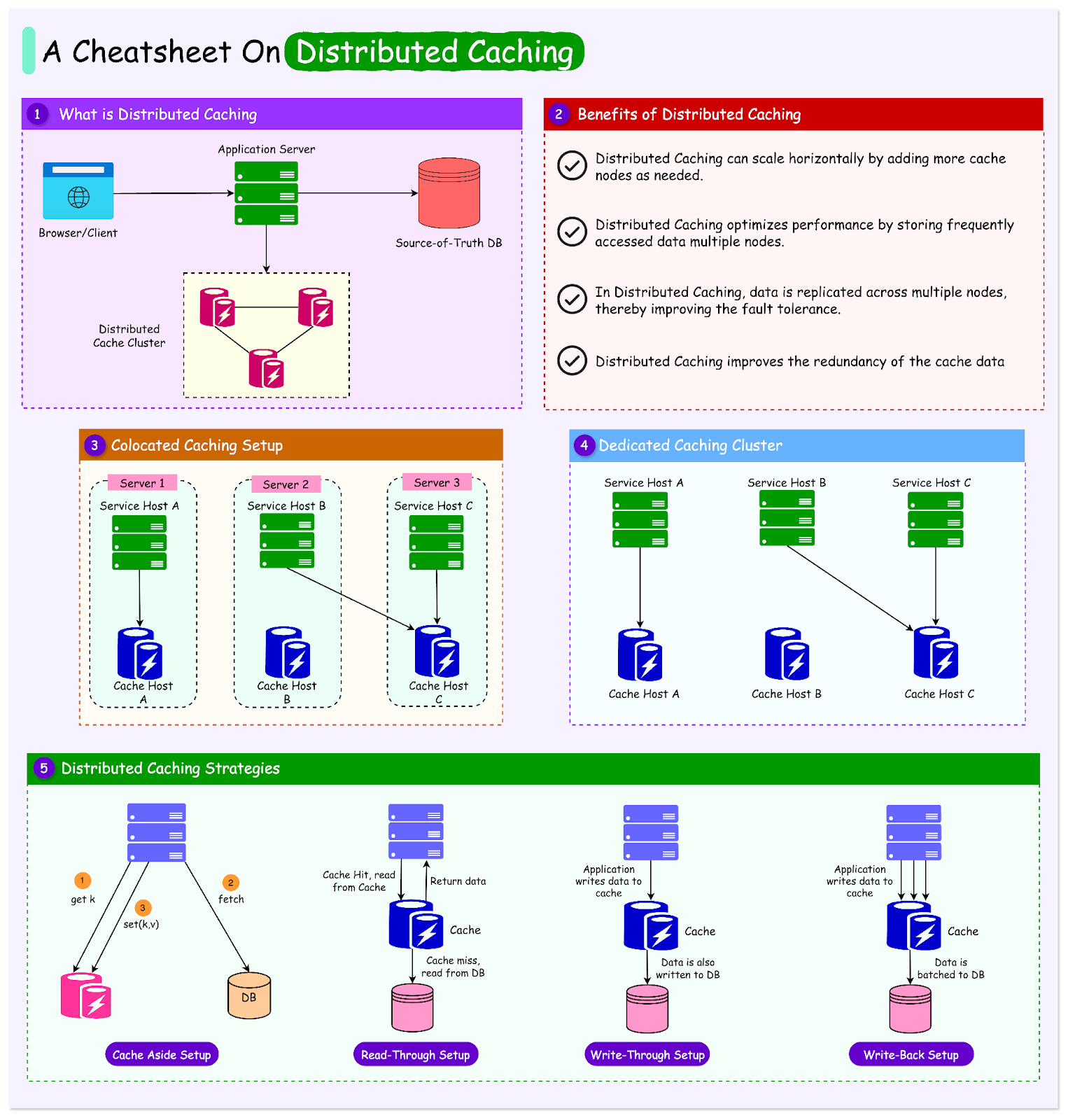
Why Distributed Caching?
As mentioned earlier, traditional single-node caching works well for applications with moderate user bases and limited data storage needs, but as applications grow, this approach can quickly run into major limitations.
Some significant limitations of single-node caching are as follows:
Scalability Constraints: Single-node caches are limited by the memory and processing power of a single server. As data volume and user requests grow, this single cache cannot keep up with the demand, leading to slow response times and reduced performance.
Single Point of Failure: Relying on a single cache server creates a vulnerability. If this server fails, the entire cache becomes unavailable, forcing the application to fetch all data from the primary database. This can cause critical delays, especially under high load conditions.
Inefficient Load Management: A single-node cache may struggle to handle spikes in traffic, such as during peak times for e-commerce sites or live event streaming. This overload can lead to dropped requests or severely reduced performance.
Limited Redundancy: With data stored on one node, there’s no backup if the node becomes unavailable. This lack of redundancy is a big weakness in maintaining data availability.
Benefits of Distributed Caching
Distributed caching addresses these limitations by spreading cached data across multiple nodes, creating a resilient, scalable caching layer that can grow with an application’s demands.
The diagram below shows a typical distributed caching setup.
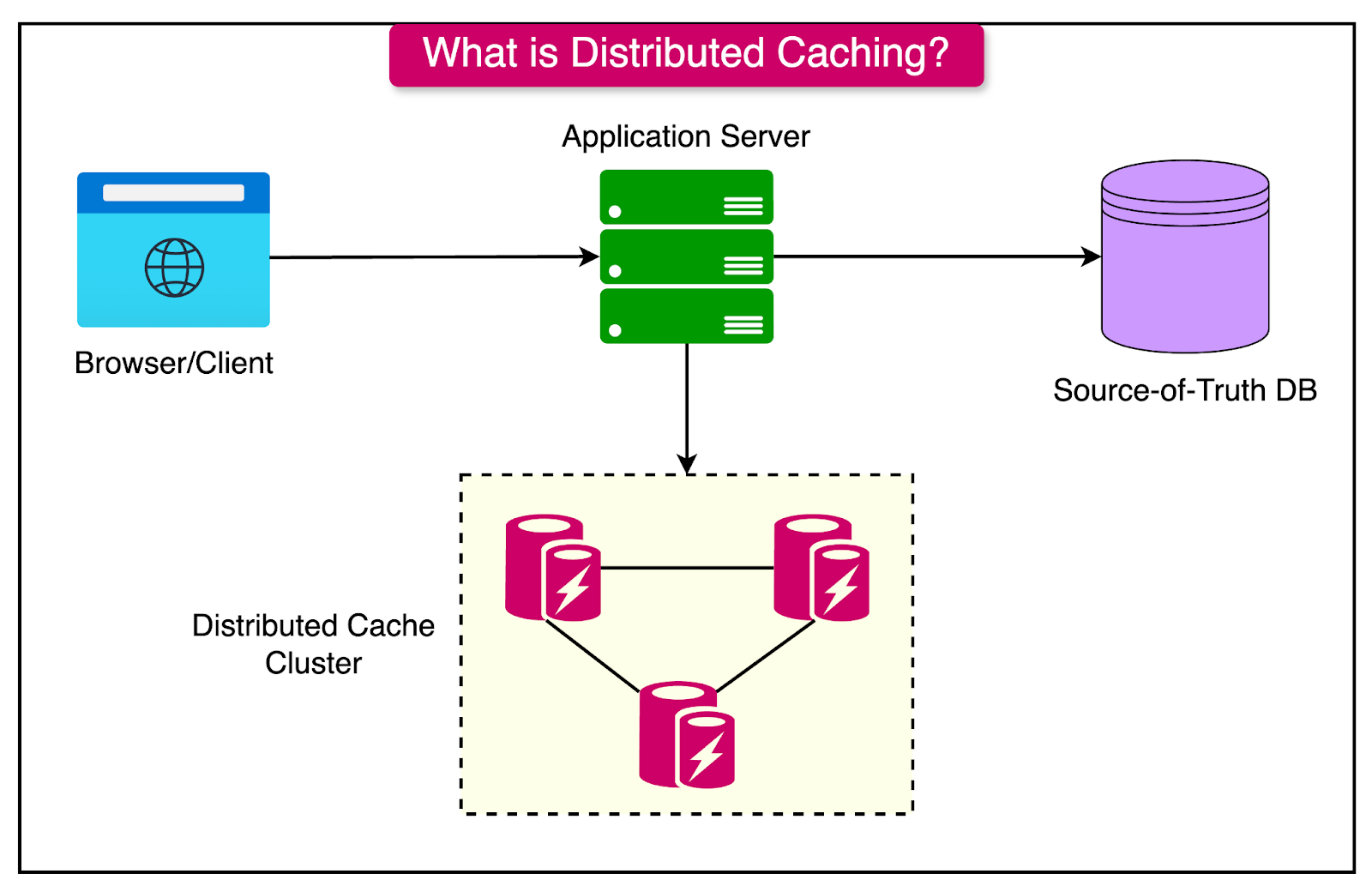
Here’s how distributed caching enhances scalability, performance, and fault tolerance:
Scalability: Distributed caching can scale horizontally by adding more cache nodes as needed. Each node holds a portion of the data, reducing the load on any single node and allowing the system to handle millions of users and vast datasets seamlessly.
Performance Optimization: By storing frequently accessed data across multiple nodes, distributed caching improves response times.
Fault Tolerance: In a distributed cache, data is replicated across multiple nodes, so if one node fails, other nodes can continue to serve cached data without interruption. This redundancy is crucial for high-availability applications since it ensures that the system remains operational even if individual nodes go offline.
Practical Examples
Here are some practical examples where distributed caching becomes necessary:
Peak-Time E-Commerce Traffic: E-commerce sites experience high traffic during peak events, such as Black Friday or holiday sales. Distributed caching helps distribute the load across multiple nodes, preventing system slowdowns and providing users with a fast, reliable shopping experience. Key data like product information, prices, and user sessions can be cached across several nodes, allowing quick access even under heavy load.
Live Sports Streaming: For live sports platforms, delivering real-time video feeds and game statistics to millions of viewers is essential. Distributed caching allows video fragments and metadata to be cached across multiple nodes, ensuring smooth streaming and minimizing latency.
How Distributed Caching Works?
The architecture of distributed caching is designed to address the scalability and performance needs of large-scale applications by distributing cached data across multiple servers or nodes.
Here are the key components of a typical distributed caching architecture:
Cache Nodes: In a distributed cache, data is spread across multiple servers or nodes. Each cache node holds a portion of the cached data, allowing the entire cache to scale horizontally as more nodes are added. The cache nodes work together to respond to data requests, share the workload, and provide redundancy in case of node failure.
Client Libraries: A client library acts as an intermediary between the application and the distributed cache nodes. It determines which node stores the data the application needs and routes requests accordingly. The client library also handles data distribution, manages data retrieval, and ensures the application interacts with the correct cache nodes.
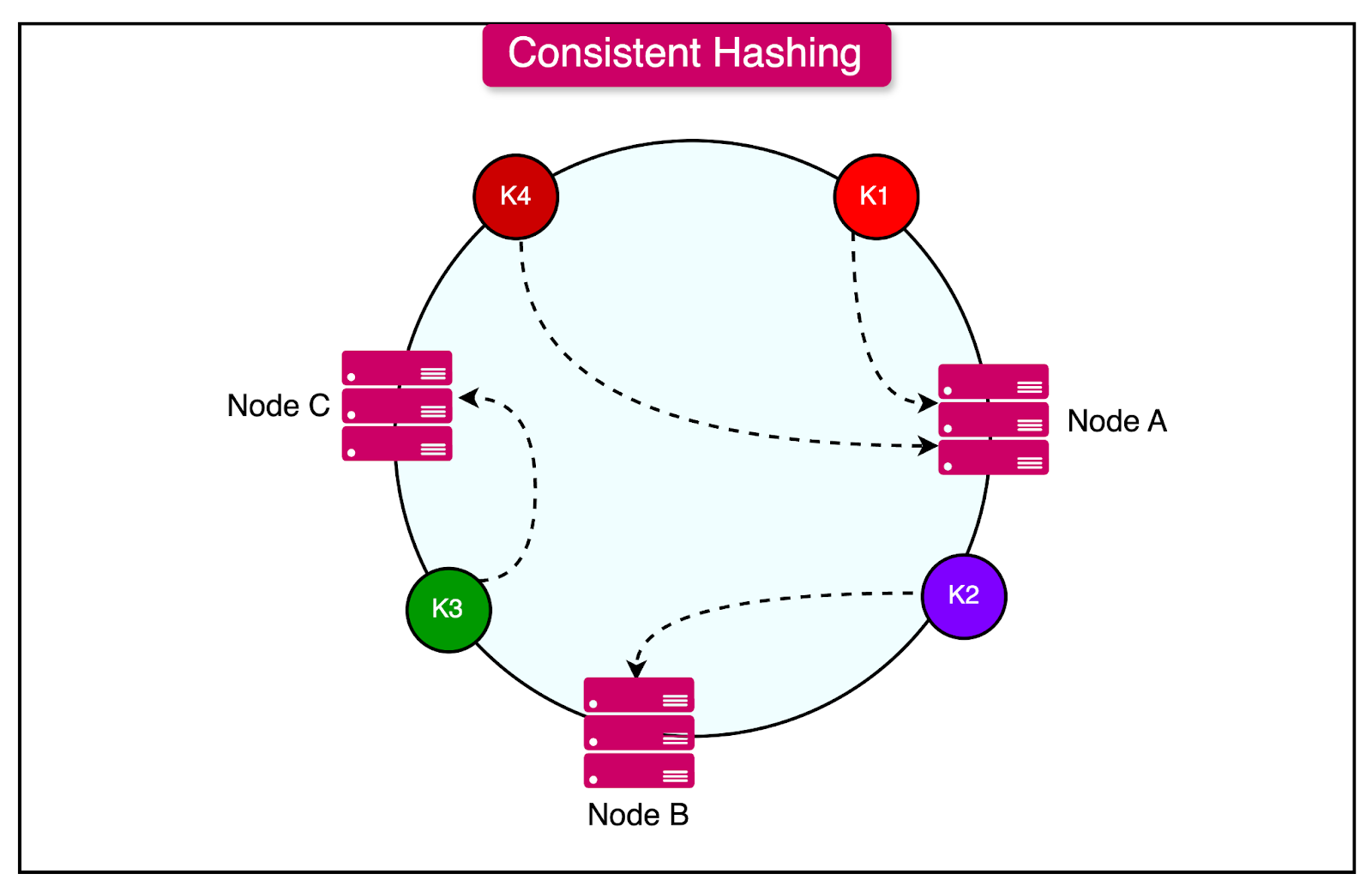
Consistent Hashing: Distributed caches often use consistent hashing to distribute data efficiently across multiple nodes. This hashing technique assigns data to specific nodes based on a hash of the data key. Consistent hashing is designed to minimize data movement when nodes are added or removed, helping maintain cache stability and reducing reallocation costs.
Data Replication: Distributed caches often use replication to improve fault tolerance. When data is cached on one node, it is also copied to a backup node. If the primary node becomes unavailable, the backup node can continue to serve the data, ensuring uninterrupted access.
The diagram below shows the concept of consistent hashing to distribute keys across nodes.
How Data Retrieval Works in Distributed Caching
Here’s a step-by-step example to demonstrate how data retrieval works in a distributed cache, highlighting the process of a cache hit versus a cache miss:
Data Request: Suppose an application needs to retrieve a frequently accessed piece of data, such as a user’s session details. The application sends a request for this data to the cache.
Determining Data Location: The client library receives the request and, using consistent hashing, determines the appropriate cache node that should contain this specific piece of data based on its key.
Cache Hit Scenario:
If the data is found on the designated cache node (a “cache hit”), the cache node retrieves the data and sends it back to the client library.
The client library then returns the data to the application, fulfilling the request quickly without the need to query the primary database.
Cache hits reduce latency and improve application performance by delivering the requested data directly from the cache.
Cache Miss Scenario:
If the requested data is not available on the cache node (a “cache miss”), the client library forwards the request to the primary database or data source.
Once the database retrieves the data, it is returned to the application. The client library may then store this data on the appropriate cache node so it’s available for future requests, converting the cache miss into a cache hit on subsequent requests.
Data Replication (Optional): If replication is enabled, the cached data may also be copied to a backup node to ensure high availability. Should the primary node fail, the client library can route future requests to the backup node.
Load Balancing via Sharding: Sharding ensures that large data sets and heavy request loads are evenly distributed across cache nodes. When a new cache node is added, consistent hashing helps rebalance the data distribution without significant data reallocation.
Hosting and Deployment Options
When implementing distributed caching, organizations have various hosting options to choose from, each with its benefits and trade-offs.
Let us compare the main options for hosting distributed caches: dedicated cache servers, co-located caching, and cloud-based caching services.
Dedicated Cache Nodes
Dedicated cache nodes are standalone machines or virtual instances specifically allocated for caching.
See the diagram below:
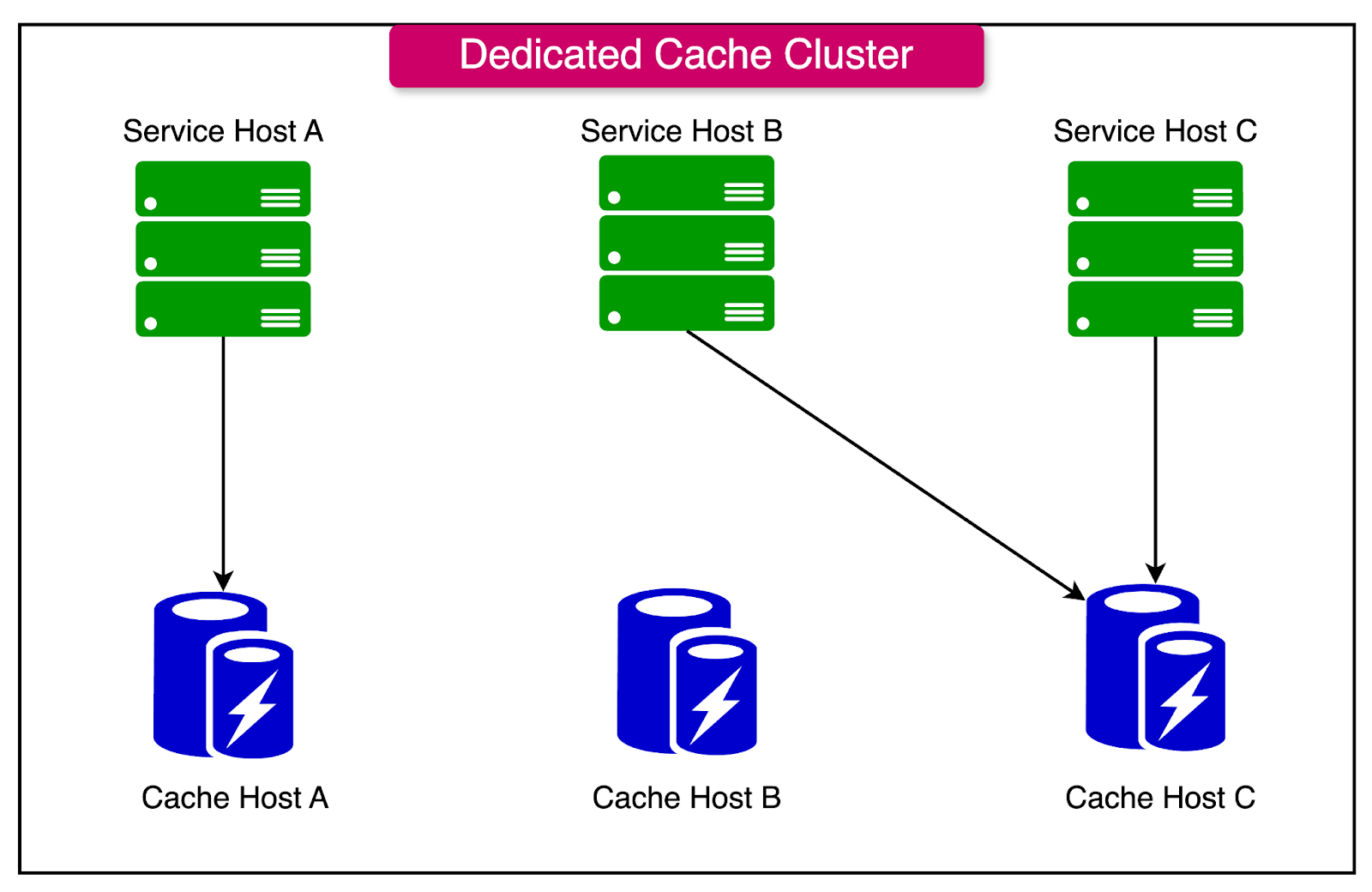
They are separate from application servers, allowing them to handle caching tasks exclusively, without interference from application-level processes.
The main advantages of this setup are as follows:
Scalability: Dedicated cache servers can be independently scaled to match application growth. As demand increases, more dedicated cache nodes can be added without affecting application servers, making it a flexible solution for larger, high-traffic applications.
Resource Isolation: Since dedicated cache servers are separate from application servers, they prevent cache-related activities from consuming resources needed for application processing. This isolation helps maintain stable performance, as caching processes don’t compete for CPU or memory with other tasks.
The disadvantages are as follows:
Network Latency: Because dedicated cache servers are separate from application servers, accessing cached data requires network calls between the servers. This can introduce latency, especially in real-time applications where even minor delays impact performance.
Higher Costs: Operating separate cache servers can be expensive, particularly when handling high cache traffic or when redundancy is required for fault tolerance. These costs can add up, as each dedicated server incurs hardware, maintenance, and energy expenses.
Co-located Caching
In co-located caching, the cache and application server run on the same physical machine or virtual instance.
See the diagram below for reference:
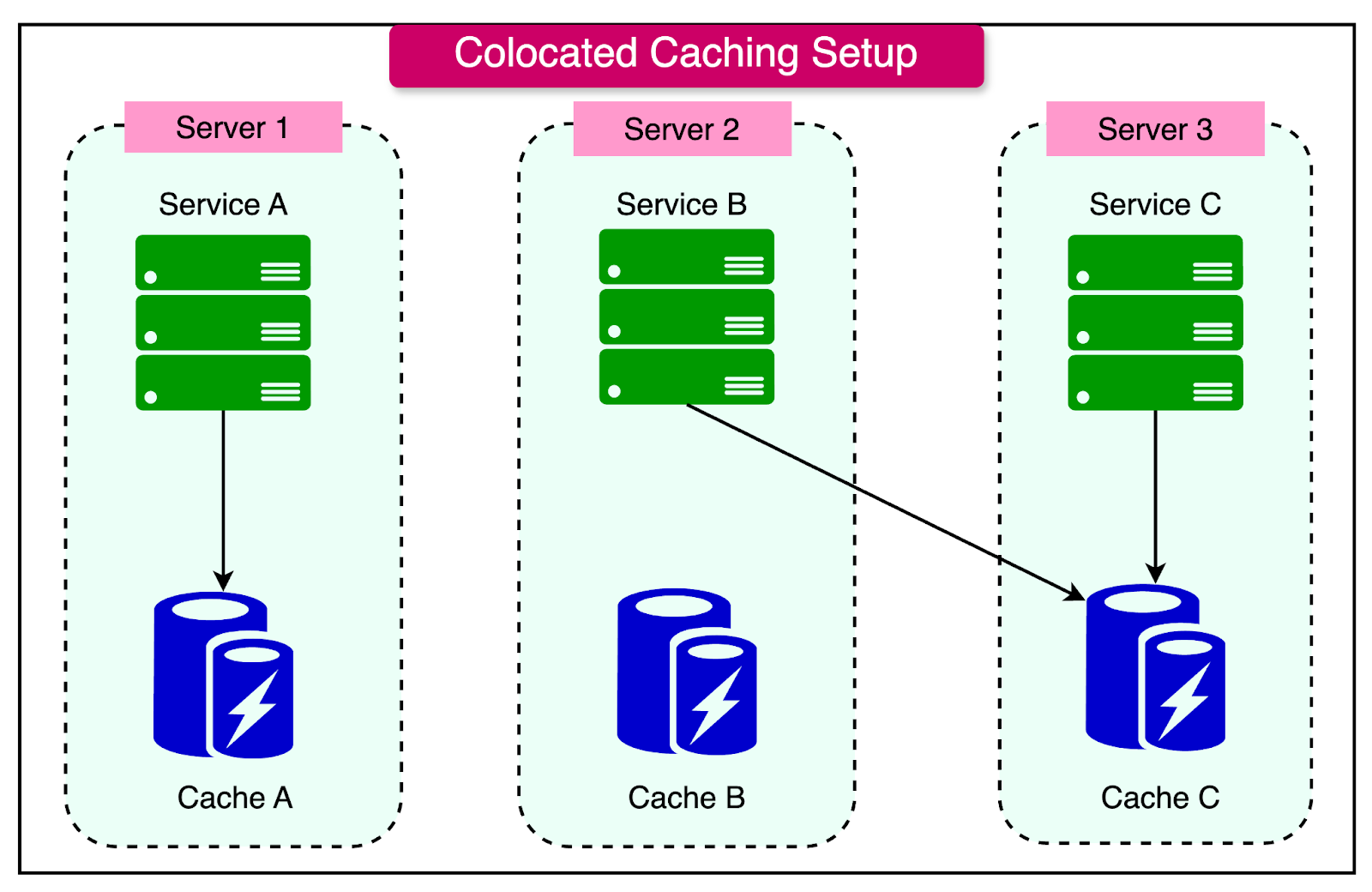
This setup leverages shared resources for both caching and application processes, which can simplify infrastructure management and reduce operational costs.
Here are the main advantages of this setup:
Low Latency: Since the cache resides on the same server as the application, data retrieval is faster and eliminates the network latency associated with remote cache servers.
Cost Efficiency: Co-locating the cache with the application server is often more cost-effective than dedicated caching, especially for smaller applications.
However, this setup also has some drawbacks:
Resource Contention: With caching and application processes sharing the same resources (CPU, memory, I/O), there is a risk of resource contention. High cache usage could strain the server, affecting application performance, especially under heavy load.
Limited Scalability: Co-located caching setups are less scalable than dedicated cache servers. Scaling the cache would require upgrading the entire server, which may be cost-prohibitive or technically challenging for large-scale applications.
Cloud-Based Caching Solutions (e.g., Amazon ElastiCache)
Cloud-based caching services, such as Amazon ElastiCache, offer fully managed, scalable caching solutions that can be set up in minutes and adapted to various application requirements.
See the diagram below for an example of such a setup on a global scale.
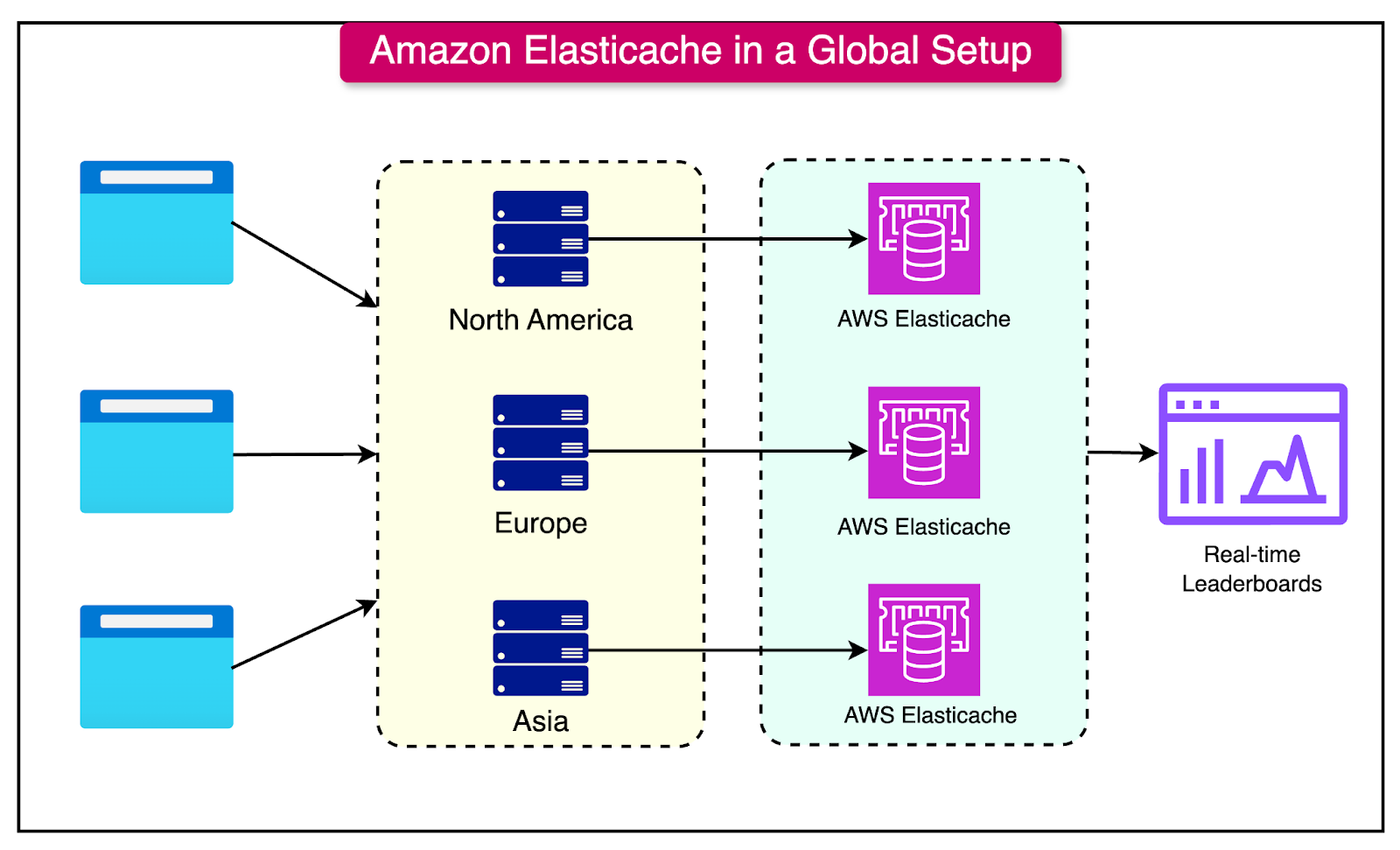
These solutions support popular caching engines, including Redis and Memcached, and provide a suite of features tailored for enterprise-scale caching.
The key advantages of this setup are as follows:
Auto-Scaling: Cloud caching solutions typically offer auto-scaling capabilities, allowing the cache infrastructure to automatically adjust based on demand. This dynamic scaling is extremely useful during unexpected traffic surges.
Multi-Zone Deployment: Managed cloud services support multi-AZ (Availability Zone) deployments, ensuring high availability and fault tolerance.
Simplified Management: Cloud providers handle setup, maintenance, patching, and monitoring, allowing development teams to focus on application-level concerns rather than infrastructure. They also offer integration with other cloud services, making it easier to manage distributed cache in a cloud-native environment.
Flexible Cost Model: Cloud caching services often have pay-as-you-go pricing, which can be more cost-effective for growing applications. Organizations can scale up or down based on demand, paying only for the resources they use, which is an advantage over fixed-cost on-premise solutions.
The drawbacks are as follows:
Dependency on Cloud Provider: Using a managed cloud service can lead to vendor lock-in, as it may be challenging to migrate cache data or configurations to another provider. This dependency can become a consideration for companies with strict data governance policies or multi-cloud strategies.
Network Costs and Latency: Although data retrieval is fast, accessing cloud-hosted caches still involves network overhead, which can incur additional data transfer costs and latency, particularly for applications with extremely high data-access demands.
Caching Strategies in Distributed Systems
Distributed caching relies on various strategies to optimize data retrieval and ensure consistency between the cache and data sources.
These caching strategies are designed to accommodate different data access patterns and application requirements, such as data freshness, latency, and consistency.
Let’s look at them in more detail.
Cache-Aside (Lazy Loading)
Cache-aside, also known as lazy loading, is a strategy where data is loaded into the cache only when it’s explicitly requested by the application.
In this model, the cache does not preemptively store data. Instead, when an application requests a specific data item:
If the data is found in the cache (a cache hit), it is returned immediately, providing fast access.
If the data is not in the cache (a cache miss), the application retrieves it from the primary data source, such as a database, and then stores a copy in the cache for future requests.
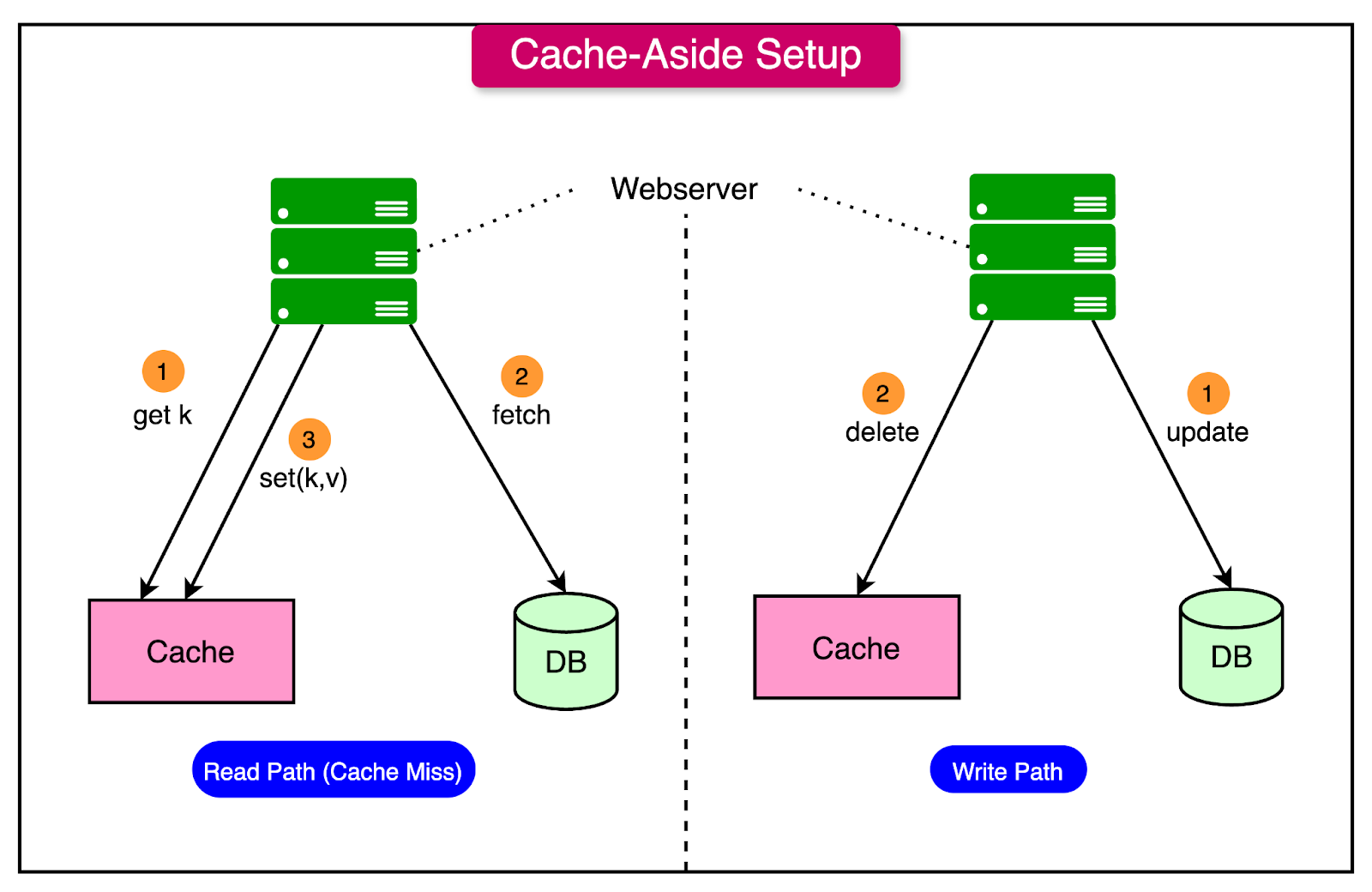
This strategy minimizes the amount of cached data, as only frequently accessed items are stored. Cache-aside is popular because of its simplicity and efficiency; it’s particularly useful when applications don’t need to cache all data upfront and when cached data changes infrequently.
The pros of this strategy are as follows:
Simple and efficient, only caching data as needed.
Reduces memory usage by caching only popular or recently accessed items.
However, it also has a disadvantage:
On a cache miss, there may be a delay as the data is retrieved from the database, creating a “cold start” effect for less frequently accessed data.
Read-Through Caching
In a read-through caching strategy, the cache sits directly in front of the database, and all read requests pass through the cache. Here’s how it works:
When the application requests data, the cache checks if it has the requested item.
If the item is present (cache hit), it is returned directly from the cache.
If the item is not in the cache (cache miss), the cache itself retrieves the data from the database, returns it to the application, and stores it in the cache.
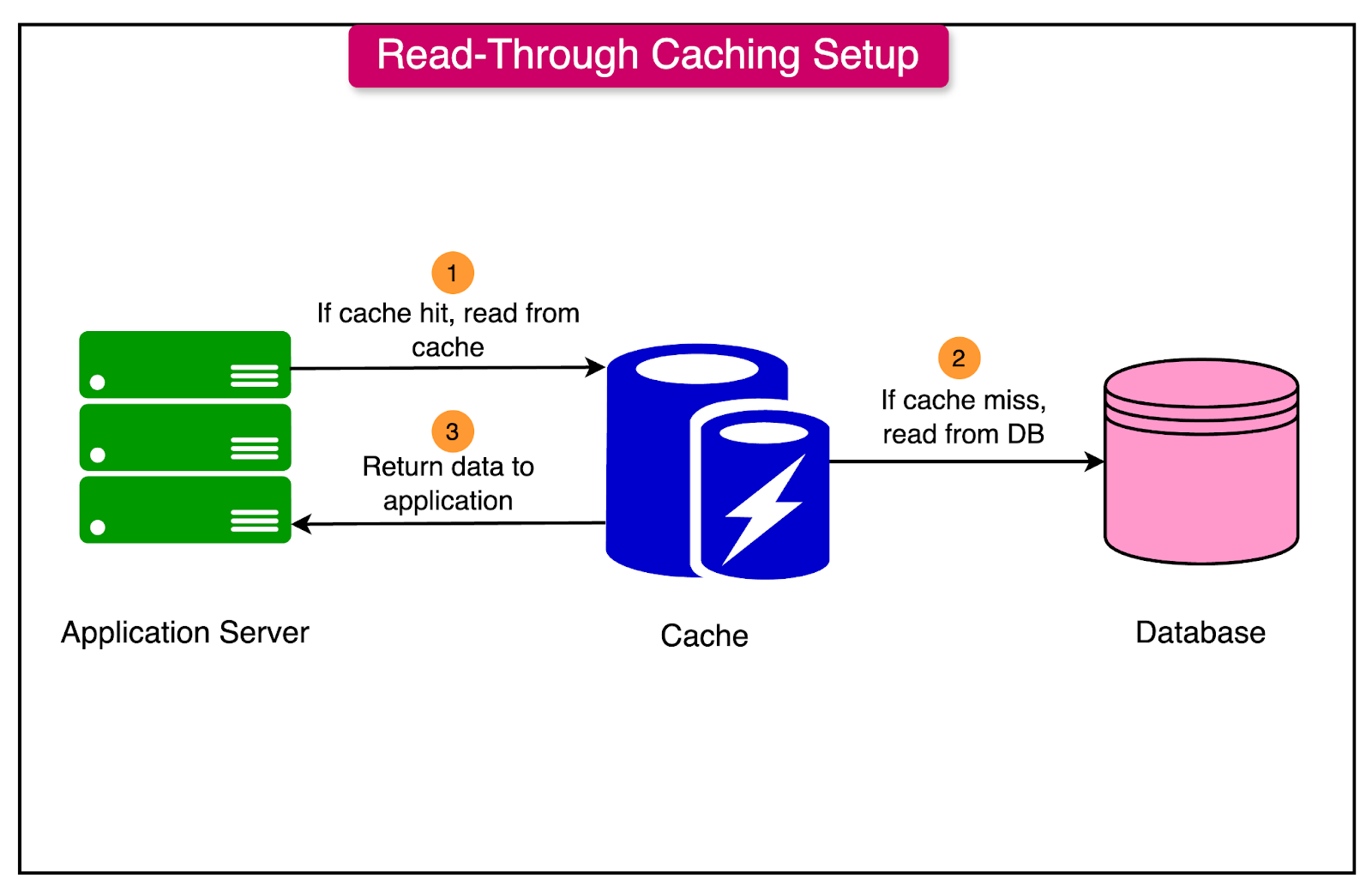
Read-through caching is commonly used in managed caching solutions (e.g., Redis and Amazon ElastiCache), as it keeps the caching mechanism within the cache layer, reducing the logic required in the application code.
The advantages of this approach are as follows:
Streamlines the data flow by handling cache misses within the cache layer.
Reduces cache management complexity in the application code.
There is also a disadvantage:
Limited control over cache population, as all reads go through the cache.
Write-Through Caching
Write-through caching is a strategy that ensures data consistency by immediately writing updates to both the cache and the primary data store.
When an application updates data:
The write operation is performed on the cache and then immediately forwarded to the database.
The updated value is stored in both the cache and the primary data source, keeping them consistent with each other.
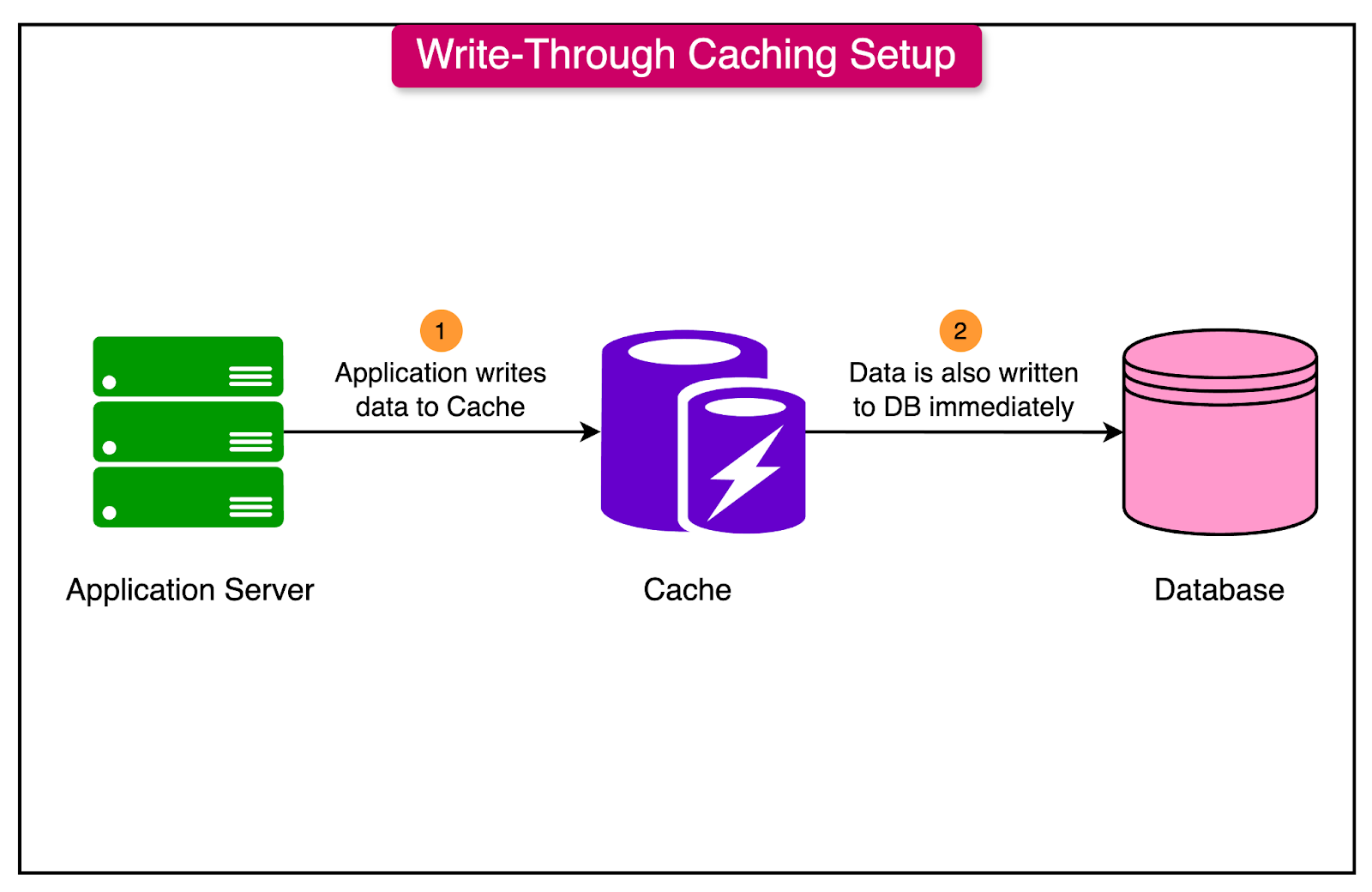
Write-through caching is useful for applications that require data consistency, as it ensures that any changes to the data are immediately reflected in both the cache and the database. It’s especially helpful in scenarios where read requests may come soon after a write operation, as the data in the cache is always up to date.
Here are the key advantages of this approach:
Keeps data in the cache and the database consistent at all times.
Ideal for applications with frequent updates where cached data must remain current.
However, there are also some disadvantages:
Write operations can be slower, as they must update both the cache and the database.
Increased complexity in handling large volumes of write operations.
Write-Back (Write-Behind) Caching
Write-back caching, also known as write-behind caching, optimizes write operations by temporarily storing updates in the cache and deferring their write to the primary data store.
Here’s how it works:
When the application writes data to the cache, the update is held in the cache without immediately writing it to the database.
The cache periodically synchronizes updates with the database in the background, which reduces the number of direct writes to the database and improves overall write performance.
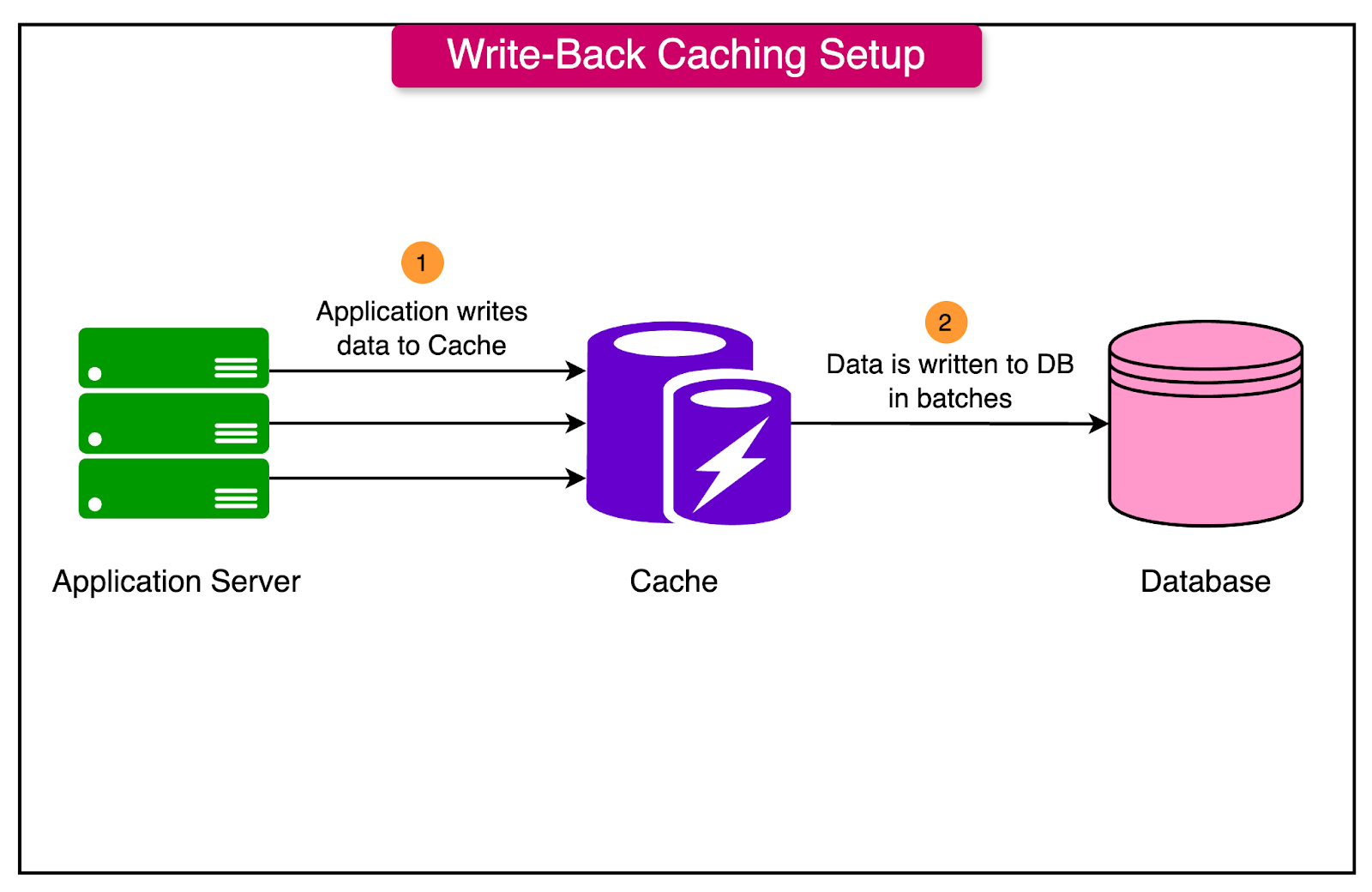
The advantages of this approach are as follows:
It enhances performance by reducing the number of immediate writes to the database.
Suitable for write-intensive applications that can tolerate some latency in data persistence.
The main disadvantages are as follows:
Increased risk of data loss in case of cache failure before writes are synchronized.
Potential for cache inconsistency, especially if reads occur before the cache writes back to the database.
Cache Consistency and Synchronization in Write-Heavy Applications
Maintaining consistency between the cache and the primary data source is a critical challenge, especially in write-heavy applications where data is frequently updated.
Here are some strategies to ensure cache consistency:
Cache Invalidation: This strategy removes stale or outdated data from the cache, ensuring that the next request will pull fresh data from the database. Invalidation can be triggered based on time (Time-to-Live or TTL) or events (e.g., a database update).
Write-Through Consistency: Write-through caching, as discussed, maintains consistency by updating both the cache and the database simultaneously. While this approach can introduce latency, it ensures that cached data is always synchronized with the primary data source.
Event-Based Updates: For applications with complex data flows, an event-based approach can be used to synchronize cache data. For example, if a database update event occurs, a corresponding event can trigger the cache to update or invalidate affected items, keeping the cache in sync.
Leasing: In a distributed cache environment, multiple nodes may try to modify the same data simultaneously. Leasing ensures that only one operation can update a cache entry at a time, preventing conflicts and maintaining data consistency across nodes.
Challenges with Distributed Caching
Distributed caching does not come without its own set of challenges. A lot of the challenges associated with distributed systems show up when dealing with distributed caching.
Here are a few major challenges along with their possible mitigation strategies:
Data Consistency Issues
In distributed caching, data consistency becomes a significant challenge, especially when cached data requires frequent updates. In applications with high write frequencies, ensuring that all cache nodes hold the most recent data is complex.
If one node holds stale data while another has the updated value, it can lead to inconsistent application behavior and errors.
The mitigation strategies for this situation are as follows:
Write-Through Caching: Updates the cache and the primary data store simultaneously, keeping data in sync.
Event-Based Triggers: Using events to synchronize cache and database updates by invalidating or updating relevant cache entries when data changes.
Leasing: Ensures that only one node can modify a cache entry at a time, preventing conflicts in write-heavy environments.
Network Partitioning
Network partitioning, or temporary network failures, can disrupt communication between cache nodes, isolating portions of the cache from the rest of the system. This “split-brain” scenario can result in nodes operating independently with outdated or inconsistent data.
During a partition, nodes may independently handle read/write requests, leading to divergent cache states that are difficult to reconcile when the network is restored.
The mitigation strategies for this challenge are as follows:
Partition-Aware Architectures: Designing the system to handle partial data access gracefully in case of partitioning.
Quorum-Based Consensus: Ensuring that only a subset of nodes can operate during a partition to avoid conflicting data states, requiring consensus for updates.
Cache Invalidation and Expiration Strategies
Invalidation and expiration strategies are essential for keeping cached data fresh, especially in applications where data changes frequently.
TTL settings automatically expire data from the cache after a specified duration, ensuring that stale data doesn’t persist indefinitely. However, setting appropriate TTLs can be complex, as too short a TTL may cause excessive cache misses, while too long a TTL risks serving outdated data.
The key challenges are as follows:
Overhead of Frequent Invalidations: Frequent invalidations, especially in highly dynamic systems, can degrade cache performance and increase the load on the primary data store.
Complexity of Implementing Event-Based Invalidation: Configuring invalidation to trigger accurately based on specific events (e.g., database updates) adds complexity to the cache management process.
For complex applications, manual or event-triggered invalidation can ensure that cache entries are cleared or updated precisely when changes occur.
Load Balancing and Latency
In distributed caching, balancing the load across multiple cache nodes is essential to prevent overloading any single node.
Replicating data across nodes, especially in real-time applications, can introduce latency. Data synchronization between nodes needs to be fast to maintain data freshness and prevent lag during high-load periods.
Data replication, especially in write-heavy systems, can slow down performance as nodes continually update the replicas.
Some mitigation strategies for this situation are as follows:
Consistent Hashing: Ensures even data distribution and minimizes reallocation when nodes are added or removed, improving load balancing.
Replication with Selective Sharding: Dividing data into shards and only replicating high-priority data can reduce replication-related latency and resource consumption.
Monitoring and Adaptive Scaling: Monitoring system load in real-time and dynamically adjusting cache node allocation can help balance traffic and minimize latency.
Popular Distributed Caching Solutions
Let’s now look at some popular distributed caching solutions available to developers. Each of these caching solutions offers unique strengths and capabilities.
Redis
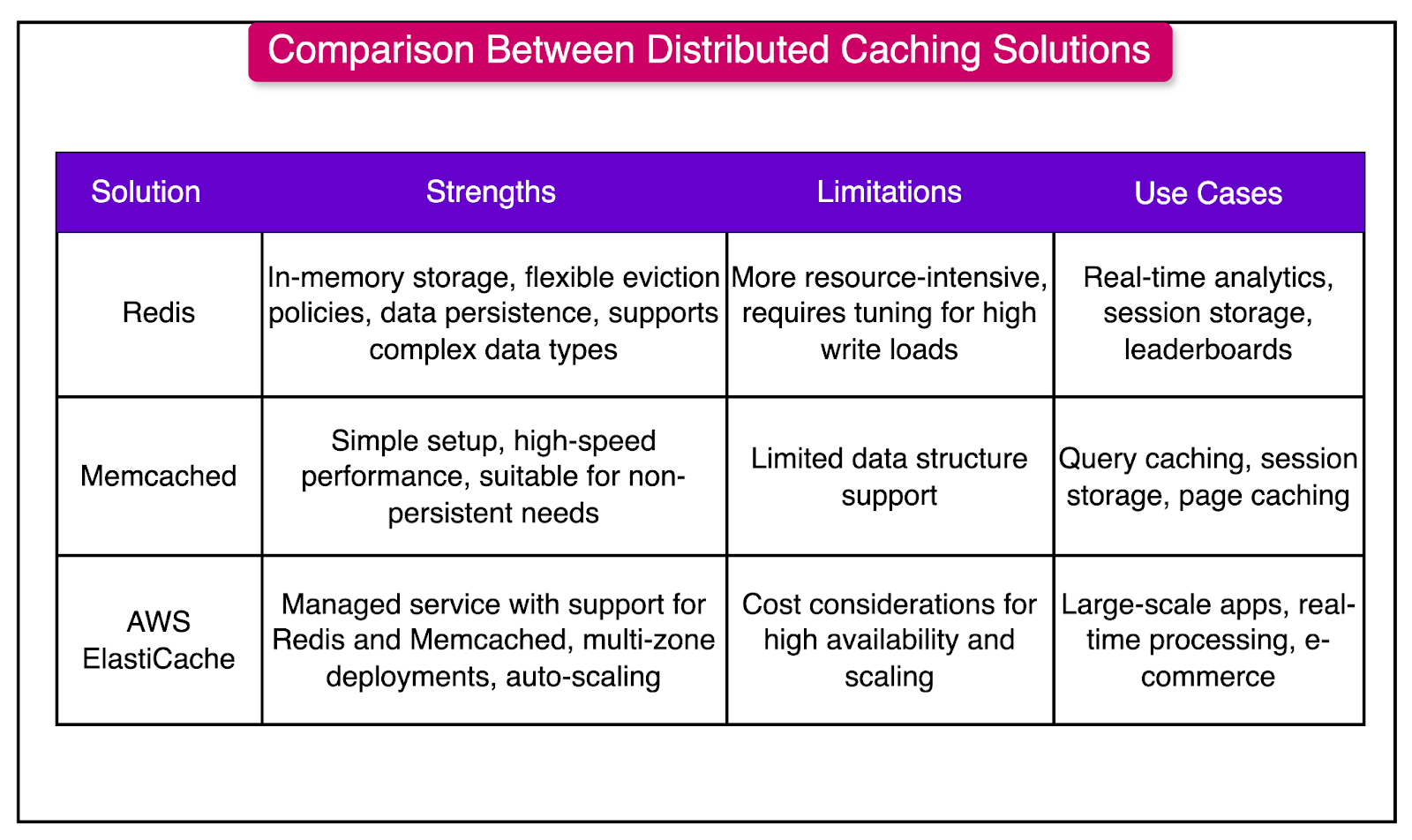
Redis is a widely used, formerly open-source, in-memory data store that supports various data structures, making it highly versatile as a cache, database, and message broker.
It has several strengths such as:
In-Memory Storage: Stores data entirely in memory, making it extremely fast for read and write operations.
Eviction Policies: Offers flexible eviction policies, including Least Recently Used (LRU) and Least Frequently Used (LFU), helping optimize memory usage.
Data Persistence: Redis provides optional persistence through snapshotting and append-only file (AOF) modes, ensuring data durability even in case of power loss.
Advanced Data Structures: Redis supports lists, sets, sorted sets, hashes, and more, making it ideal for complex caching needs.
The primary use cases for Redis are:
Real-time analytics
Session storage
Leaderboards and counters
Publish/subscribe message queues
Memcached
Memcached is a lightweight, open-source, in-memory caching system designed for simplicity and speed.
It’s well-suited for applications that don’t require persistent storage or complex data structures.
The key strengths of Memcached are as follows:
Simplicity: Memcached is straightforward to set up and use, focusing purely on caching without additional features.
High-Speed Performance: With minimal overhead, Memcached is highly efficient for quick data retrieval in applications with high read and write throughput.
Distributed Architecture: Supports horizontal scaling, allowing data to be spread across multiple nodes.
The primary use cases are as follows:
Database query caching
Simple session storage
Caching of rendered web pages or HTML fragments
Reducing load on backend services in high-traffic web applications
Amazon ElastiCache
Amazon ElastiCache is a fully managed, scalable caching service from AWS that supports both Redis and Memcached, providing flexible deployment options for distributed caching.
Its fundamental strengths are as follows:
Managed Service: AWS handles maintenance, patching, scaling, and failover, allowing developers to focus on application logic.
Multi-Zone Deployments: Supports multi-zone deployments for high availability and fault tolerance, making it suitable for mission-critical applications.
Auto-Scaling and Monitoring: ElastiCache offers automated scaling and integrates with Amazon CloudWatch for real-time monitoring.
Choice of Engines: Users can select between Redis for advanced data features or Memcached for lightweight caching needs.
The key use cases of ElastiCache are:
Large-scale web applications
E-commerce platforms with dynamic content caching
Real-time data processing and high-performance applications
The table below summarizes the strengths and limitations of the three major distributed caching solutions we’ve discussed.
Summary
In this article, we’ve taken a detailed look at distributed caching and its role in building high-performance applications.
Let’s summarize our learnings in brief:
Distributed caching is a caching technique that spreads data across multiple servers to improve scalability, performance, and fault tolerance in large-scale applications.
The core components of a distributed cache include cache nodes, client libraries, data replication, and techniques like sharding and consistent hashing.
Common hosting options for distributed caching are dedicated cache servers, co-located caching, and cloud-based caching solutions, each with distinct advantages and drawbacks.
Key caching strategies in distributed systems include cache-aside (lazy loading), read-through, write-through, and write-back caching, each suited to different data access needs.
Distributed caching presents several challenges, including data consistency issues, network partitioning, cache invalidation, and load-balancing complexities.
Popular distributed caching solutions include Redis, which offers in-memory storage, flexible eviction policies, and data persistence; Memcached, known for its simplicity and speed; and Amazon ElastiCache, a managed service providing support for both Redis and Memcached with multi-zone deployments and auto-scaling capabilities.


